
The PT-141 peptide (bremelanotide) is a synthetic peptide that activates melanocortin receptors in the central nervous system, and it is studied for its ability to increase sexual desire and arousal. It is an unusual compound, because a prescription medicine of the same name exists for one narrow use, while research-labeled material is a separate category. This guide explains what PT-141 is, what the studies found, how it works and how fast, and what the dosing numbers in trials mean. It describes research only and is not advice for any person.
What Is PT-141?
PT-141 is the lab name for bremelanotide. A 2019 review in Drugs describes it as a man-made copy of alpha-MSH, a natural messenger the body makes. Wikipedia describes it as a ring-shaped chain of seven amino acids, the building blocks of proteins.
Its family story starts with tanning research at the University of Arizona in the 1980s, which produced a compound called melanotan II. According to Wikipedia, PT-141 is a breakdown product of melanotan II that is missing one tiny chemical group at the end of the chain. The melanotan II guide covers that parent compound.
According to Wikipedia, a prescription version was approved in the United States in June 2019 for premenopausal women with a specific type of low sexual desire. That approval covers one product and one use. It does not cover research material, and it does not cover men.
Can the PT-141 Peptide Boost Libido?
In women, the best evidence says it can raise desire a little, with caveats. Two large trials called RECONNECT, published in 2019 in Obstetrics and Gynecology, enrolled 1,267 premenopausal women with low sexual desire that caused them distress. They received an injection as needed, or a placebo (an inactive look-alike), for 24 weeks. Women on PT-141 scored higher on a desire questionnaire, with an average gain of 0.35 points over placebo, and felt less distress, with an average drop of 0.33 points. Both trials were paid for by the companies that developed the drug.
A 2024 critique in the Journal of Sex Research argues the gains were small and that the questionnaires used may not measure desire well. It also found that 8 of the 11 results registered in advance on ClinicalTrials.gov were never published. A 2026 review in the Journal of Minimally Invasive Gynecology, covering 36 studies, took a wider view. It found PT-141 improved desire and arousal scores, and that talk therapy, a daily pill for desire, and PT-141 all reduced distress. Nobody has compared them head to head.
For men, the studies did not test libido. They looked at erections, covered below. The evidence shows a modest effect on desire in one group of women, while evidence for other groups remains thin.
See also: Why Peptides Are Becoming Part of the Women’s Longevity Conversation
PT-141 Benefits and Uses in Research
Researchers have studied PT-141 for three main purposes:
- Low desire in women. This is the approved use and has the most evidence, including the large trials above.
- Arousal in women. A small 2006 trial in the Journal of Sexual Medicine gave 18 premenopausal women a single nasal dose. They reported more desire and more satisfying arousal than on placebo, though a measure of blood flow in the genital area did not change.
- Erectile problems in men. Early trials in men were run in the early 2000s. They are covered in the sections on diabetes and traditional treatments.
PT-141 also belongs to a wider melanocortin family that reaches into appetite control. Wikipedia notes that a related compound is approved for weight loss in rare types of obesity. That is a separate research line.
How PT-141 Works
A receptor is a docking point on a cell. When a messenger fits into it, the cell changes what it does. PT-141 fits into melanocortin receptors, which come in five types. According to Wikipedia, it mainly switches on types 3 and 4. A 2022 review in CNS Spectrums says type 4, called MC4R, is the most important one here.
That review explains that MC4R is packed into a part of the brain called the medial preoptic area, which matters for sexual function. Lab studies suggest PT-141 switches on MC4R there and leads to more release of dopamine, a brain chemical tied to motivation and desire. A 2007 overview in the Journal of Sexual Medicine reports that in lab models, this brain area lit up and sexual behavior increased.
The key point is where it acts. A 2014 review in Expert Opinion on Investigational Drugs explains that common erection pills work on blood vessels, relaxing them so blood can flow. PT-141 works earlier in the chain, in the brain’s signaling about desire and arousal. Researchers describe this as a central approach rather than a vascular one.
How Fast Does It Work?
Not instantly, but within about an hour. Wikipedia reports that after an injection under the skin, nearly all of the dose reaches the bloodstream, the level peaks in about one hour, and the half-life, the time for the level to fall by half, is about 2.7 hours. The label for the approved product says to take it at least 45 minutes before sexual activity.
The nasal form tested in men worked a little quicker. A 2004 trial in the International Journal of Impotence Research found levels peaked in about half an hour, the half-life was about 2 hours, and the first erections appeared around 30 minutes after doses above 7 mg. That nasal form is no longer in development. Its history is covered in the section on traditional treatments.
PT-141 Research in Women
The approval covers a narrow group. According to the 2019 Drugs review, it is for premenopausal women with acquired, generalized low sexual desire that causes marked distress. In plain words, acquired means the low desire developed after a time of normal desire, and generalized means it is not limited to one partner or situation.
That is also who the trials enrolled, so their results do not speak to women outside that group. Some women in the RECONNECT trials did not benefit, and critics point out that the average gain was small. A 52-week follow-up study in which everyone knew what they were taking, published in 2019, kept 272 of 684 women to the end and found no new safety signals. The high drop-out is worth remembering when reading the long-term results.
See also: What Is Kisspeptin and What Current Research Examines
PT-141 Research in Men With Diabetes
The searches for this article found no trial of PT-141 specifically in men with diabetes. Anything claiming a proven benefit in that group goes beyond the published record.
The closest evidence is a 2008 trial in the Journal of Urology. It gave 342 men whose erectile problems had not responded to sildenafil either a nasal spray of PT-141 or a placebo. Positive results were reported in 33.5 percent of the PT-141 group and 8.5 percent of the placebo group, with more side effects on PT-141. The authors called for more studies. The abstract does not break results down by diabetes.
Safety is the other consideration. The reviews below saw small, short rises in blood pressure and advise caution in people at risk of heart and blood vessel disease. This is one reason the reviews emphasize cardiovascular caution.
What Are the Common Side Effects of PT-141?
A 2022 safety review in the Journal of Women’s Health pooled 3,500 people across 43 studies. In the main phase 3 trials, these were the most frequent problems, shown as PT-141 against placebo:
- Nausea. 40.0 percent against 1.3 percent. It was the top reason for stopping.
- Flushing. 20.3 percent against 1.3 percent. This is a warm, red face or chest.
- Headache. 11.3 percent against 1.9 percent.
- Injection site reactions. 5.4 percent against 0.5 percent.
Two further points stand out. First, darkened patches of skin were rare when dosing followed the label, but appeared in more than one-third of people after up to 16 days in a row of dosing. Second, blood pressure rose a little. A 2017 trial in the Journal of Hypertension tracked 397 women and saw systolic pressure (the top number) rise by about 2 to 3 mmHg at the two higher amounts tested, usually for under 15 minutes. Wikipedia reports the label bars use in people with uncontrolled high blood pressure or heart and blood vessel disease. The same safety review found PT-141 appeared to lower blood levels of two other medicines, indomethacin and naltrexone.
Product Details
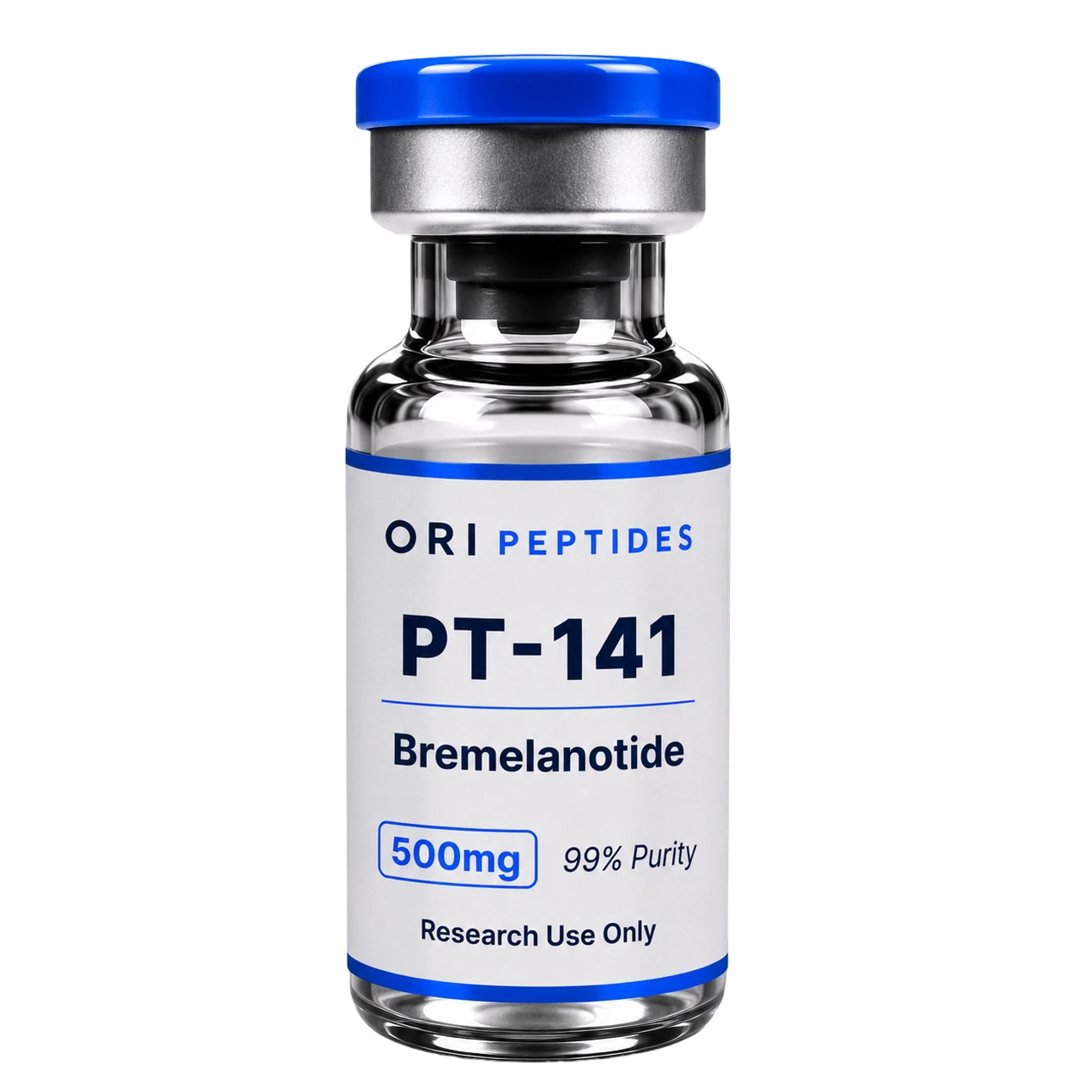
ORI Peptides lists PT-141 (bremelanotide) as research material, supplied as a freeze-dried powder in a vial. Here is what the product page states.
- Purity. At least 98 percent, verified by HPLC, a lab method that separates and measures what is in a sample.
- Storage. Keep the powder at minus 20 degrees Celsius. After mixing with liquid in the lab, store it in a refrigerator at 2 to 8 degrees Celsius.
- Paperwork. A Certificate of Analysis, the lab report for the batch, is available on request.
- Use. For laboratory research only.
Check that the Certificate of Analysis matches the batch number on your vial. Bremelanotide and melanotan II differ by one small chemical group, so identity should be shown by testing, not just by a label. A 2026 review in Missouri Medicine lists contamination, impurities, and inaccurate dosing among the risks of injectable peptides sold outside regulated channels. For mixing and storage steps, see the peptide reconstitution guide and the bacteriostatic water guide.
See also: Peptide Reconstitution Ratios & How to Calculate Them
SEXUAL WELLNESS
PT-141
How PT-141 Differs From Traditional ED Treatments
Research shows PT-141 is different from traditional ED treatments, not proven better. The main points of difference are these:
- A different target. Traditional erection pills act on blood vessels. PT-141 acts on brain signaling. That is why the 2008 trial tested it in men whose pills had not worked, and why 33.5 percent versus 8.5 percent on placebo drew interest.
- Not tied to a daily pill. The approved form is taken as needed, about 45 minutes ahead, rather than as a regular tablet.
- Early speed. The nasal form began to work in about 30 minutes in a 2004 trial.
The limits are just as important. PT-141 is not approved for erectile problems. According to Wikipedia, the FDA halted trials of the nasal form for erectile and arousal problems in 2007 because of blood pressure increases, and development of that form stopped in 2008. The 2008 trial reported more side effects than placebo, and nausea and flushing were the most common problems in the nasal studies. Traditional treatments also have a much longer record of study. No trial found compares PT-141 head to head with them.
PT-141 Dosage in Published Research
Dosing is where research and everyday talk get confused, so here is what trials reported and what it means. These are amounts used in clinical trials of the approved product. They are not instructions for research material, which each lab handles under its own protocol and ethics approval.
- Women, injection. In RECONNECT, the abstract reports 1.75 mg injected under the skin as needed. The 2017 blood pressure trial compared 0.75, 1.25, and 1.75 mg, and the blood pressure rise appeared at the two higher amounts.
- Men, injection. An early 2004 study in men tested 0.3 to 10 mg. Effects were clear above 1.0 mg, and 4 mg or 6 mg were used in men with erectile problems.
- Nasal form. The 2006 study in women used a single 20 mg nasal dose. The men’s nasal study found first erections after doses above 7 mg.
- Label limits. According to Wikipedia, the approved product allows one dose per 24 hours and no more than eight per month, and treatment should stop after eight weeks without improvement.
More is not better. The safety review links repeated daily dosing to skin darkening, and nausea was the top reason for stopping. For lab calculations, the concentration calculator helps with dilution math only, not with amounts for any person.
Frequently Asked Questions
What is the PT-141 peptide?
PT-141 is the research name for bremelanotide, a seven amino acid ring-shaped peptide that activates melanocortin receptors in the brain.
Is PT-141 the same as melanotan II?
No. According to Wikipedia, it is a breakdown product of melanotan II that lacks one small chemical group at the end of the chain. They are related but not identical.
Does PT-141 work on blood vessels like erection pills?
Not mainly. Research describes it as acting on the brain’s desire and arousal signals, rather than on blood vessels.
What is the most common side effect?
Nausea. It occurred in 40.0 percent of people on PT-141 in the phase 3 trials, against 1.3 percent on placebo.
Is it approved?
A prescription version was approved in the United States in 2019 for premenopausal women with a specific type of low desire. It is not approved for men. Research-labeled material is a separate category.
Why does the ORI Peptides product say research use only?
It is sold as laboratory material, not as a medicine. The evidence from prescription trials describes that product and does not carry over to research material.
Key Takeaways
- What it is. PT-141 is bremelanotide, a brain-acting peptide related to melanotan II.
- Evidence. The strongest data are two large trials in premenopausal women, with modest gains in desire and ongoing debate about how those gains were measured.
- Speed. After injection, levels peak in about an hour, and the label says to allow at least 45 minutes.
- Men. One trial in men who did not respond to sildenafil was positive, and none was found in men with diabetes.
- Side effects. Nausea, flushing, headache, and small blood pressure rises are the main findings.
- Dosing. Trial amounts apply to the approved product and are not guidance for research material.
- Quality. Identity and purity should be confirmed with a batch-specific Certificate of Analysis.
Research Use Disclaimer
This content is provided for Research Use Only (RUO). The compounds discussed are not drugs, dietary supplements, foods, or cosmetics, and are not intended for human or animal consumption, diagnostic use, or therapeutic use of any kind. They have not been evaluated by the FDA for safety or efficacy in humans. Any research use must be conducted by qualified professionals in a controlled laboratory environment, in accordance with all applicable institutional, local, and federal regulations.
Sources
- Wikipedia contributors. Bremelanotide. Wikipedia, The Free Encyclopedia.
- Dhillon S, Keam SJ. Bremelanotide, first approval. Drugs. 2019.
- Molinoff PB, Shadiack AM, et al. PT-141, a melanocortin agonist for the treatment of sexual dysfunction. Ann N Y Acad Sci. 2003.
- Pfaus JG, et al. The neurobiology of bremelanotide for the treatment of hypoactive sexual desire disorder in premenopausal women. CNS Spectr. 2022.
- Pfaus J, et al. Bremelanotide, an overview of preclinical CNS effects on female sexual function. J Sex Med. 2007.
- Ückert S, et al. Melanocortin receptor agonists in the treatment of male and female sexual dysfunctions, results from basic research and clinical studies. Expert Opin Investig Drugs. 2014.
- Kingsberg SA, et al. Bremelanotide for the treatment of hypoactive sexual desire disorder, two randomized phase 3 trials. Obstet Gynecol. 2019.
- Simon JA, et al. Long-term safety and efficacy of bremelanotide for hypoactive sexual desire disorder. Obstet Gynecol. 2019.
- Spielmans GI, Ellefson EM. Small effects, questionable outcomes, bremelanotide for hypoactive sexual desire disorder. J Sex Res. 2024.
- Toledo RG, et al. Female sexual desire, arousal, and orgasmic dysfunctions, a systematic review and meta-analysis of treatment options. J Minim Invasive Gynecol. 2026.
- Diamond LE, et al. An effect on the subjective sexual response in premenopausal women with sexual arousal disorder by bremelanotide (PT-141). J Sex Med. 2006.
- Clayton AH, et al. Safety profile of bremelanotide across the clinical development program. J Womens Health (Larchmt). 2022.
- White WB, et al. Usefulness of ambulatory blood pressure monitoring to assess the melanocortin receptor agonist bremelanotide. J Hypertens. 2017.
- Safarinejad MR, Hosseini SY. Salvage of sildenafil failures with bremelanotide, a randomized, double-blind, placebo controlled study. J Urol. 2008.
- Diamond LE, et al. Double-blind, placebo-controlled evaluation of the safety, pharmacokinetic properties and pharmacodynamic effects of intranasal PT-141 in healthy males and patients with mild-to-moderate erectile dysfunction. Int J Impot Res. 2004.
- Rosen RC, et al. Evaluation of the safety, pharmacokinetics and pharmacodynamic effects of subcutaneously administered PT-141 in healthy male subjects. Int J Impot Res. 2004.
- Moiz A, et al. Dangers of injectable peptides and other unregulated biohacking drugs. Mo Med. 2026.
Explore the sexual wellness research category for related compounds, or view the PT-141 research material.