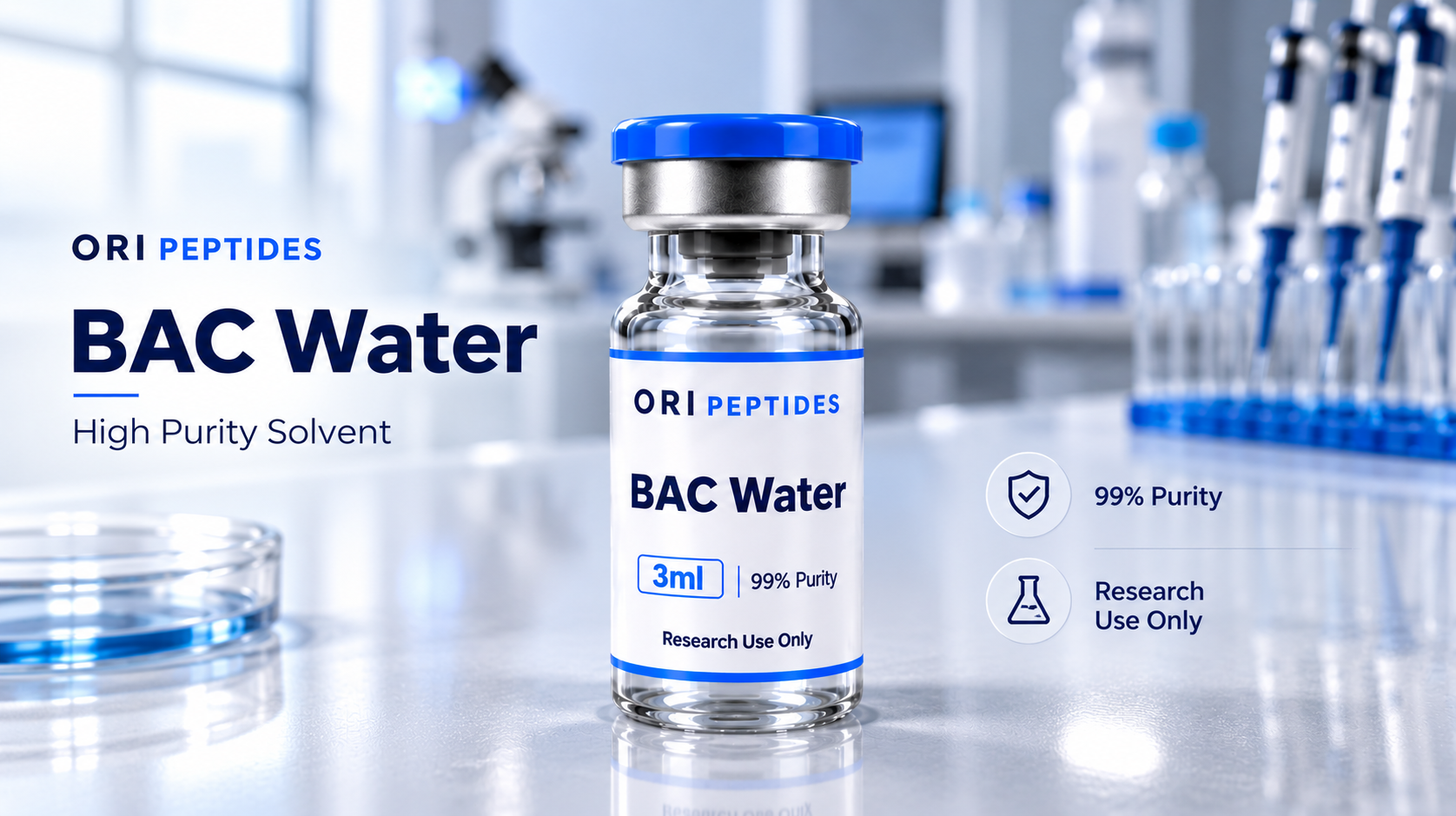
A plain-language look at what this liquid is, how it differs from plain sterile water, and why the added ingredient matters, for research reference only.
Bacteriostatic water shows up in almost every peptide reconstitution setup, usually as the second bottle sitting next to the freeze-dried compound itself. It looks and pours just like plain water, but one small added ingredient changes what it is meant for. This brief explains what that ingredient is, how this water is different from the plain sterile water used elsewhere in a lab, and a few practical details about handling it, background that pairs well with the general how to reconstitute peptides walkthrough for the compound itself.
What Bacteriostatic Water Is
This water is, at its core, regular sterile water with one thing added: a preservative called benzyl alcohol. A preservative is simply an ingredient that helps slow down bacteria growing in a liquid over time. The FDA-approved label for this product, made by companies including Hospira, lists two versions depending on the bottle:
- 0.9% benzyl alcohol (9 mg for every mL) in a 30 mL plastic vial
- A slightly stronger 1.1% (11 mg for every mL) in a 20 mL glass vial
The official label describes it as a liquid “for diluting or dissolving drugs for intravenous, intramuscular or subcutaneous injection,” in plain terms, meant to be mixed with a drug that is then injected into a vein, a muscle, or just under the skin. That is the pharmaceutical use written on the label, but the water itself is chemically the same product either way.
How It Differs From Sterile Water
The real difference comes down to that one added ingredient:
- Plain Sterile Water for Injection, the other common liquid found on the same shelf, has no preservative in it at all. Its own FDA-approved label, filed under the maker Medefil, says so directly, it “contains no bacteriostat, antimicrobial agent or added buffer” and is “supplied only in single-dose containers,” meaning one bottle is meant for one use only. Once that kind of bottle is opened, the label’s instruction is simple, throw away whatever is left, since it was never designed to be entered again later.
- Bacteriostatic water works the opposite way. It is labeled as a bottle that can be used more than once, because the added benzyl alcohol slows bacteria from building up each time a needle goes back into it.
That is exactly why it tends to be the more practical choice whenever a bottle needs to be used again and again, which is usually the case once a peptide vial has been mixed.
Why Benzyl Alcohol Matters
Benzyl alcohol does not make a bottle germ-free. Its job is smaller than that, and the name explains it, bacteriostatic means it slows down or holds back bacteria, not that it wipes out everything the instant a needle passes through the rubber top. That is exactly why a bottle meant for repeat use still has a limit on how long it stays good, rather than lasting forever once opened, more on that in the next section.
Not for Newborns. This ingredient also comes with one clear limit worth mentioning. The same label that lists 0.9 or 1.1% benzyl alcohol also warns plainly against using it in newborn babies, tracing back to a well-documented risk of harm in that age group. That is part of why plain, preservative-free Sterile Water for Injection exists as its own separate product in the first place.
Volume Choices and Shelf Life
This water comes in a few different sizes, none of these numbers are a guess, they come straight off the maker’s own label or simple arithmetic on it:
- The FDA label covers two commercial sizes, a 30 mL plastic bottle and a 20 mL glass bottle, both described above.
- For lab-scale research use, it is more commonly sold in a smaller bottle sized for a single study batch, a 3 mL bottle at 0.9% benzyl alcohol (9 mg per mL, about 27 mg in the whole bottle). This is the size sold in the shop.
Bottle size mostly comes down to planning, how many times a given batch of a compound is likely to be mixed over the course of a study before that bottle’s own time limit runs out. That planning question comes down to two numbers, the same two numbers the peptide calculator asks for:
- How many milligrams of peptide are in the vial
- How many milliliters of this water were mixed into it
Dividing the first by the second gives the concentration, in milligrams per milliliter, and that concentration is what the calculator uses, together with a chosen dose, to work out how much liquid corresponds to it.
Shelf life is a separate question from bottle size. It comes from general rules used across US pharmacies for any bottle meant to be used more than once, not from a number specific to this product printed on its own label, since Hospira’s label does not state one. The standard most pharmacies fall back on is a pharmacy safety rule called USP General Chapter 797, summarized in CDC safety guidance for injections:
- Once a reusable bottle is punctured for the first time, it should be dated and thrown away within 28 days unless the maker says otherwise
- It should never be used past the bottle’s original expiration date either way
Storage After First Puncture
Storage comes down to two points:
- Before opening: keep the bottle at 68 to 77 degrees Fahrenheit (20 to 25 degrees Celsius), which is just ordinary room temperature, no fridge needed.
- After the first puncture: what changes is mainly that 28-day clock described above, not necessarily the temperature, though many labs choose to refrigerate an opened bottle anyway once the rubber top has been used a few times, more as a precaution than a rule stated on the label.
Common Questions Researchers Ask
What is the difference between bacteriostatic water and sterile water?
- Plain sterile water has no preservative in it. Its own FDA label says so directly, it “contains no bacteriostat, antimicrobial agent or added buffer,” which is why it only comes in single-use bottles.
- This one has the preservative benzyl alcohol added instead. That is what lets its own FDA label describe it as a bottle meant for repeated use.
Does it expire or go bad over time?
Yes, in the sense that a bottle does not stay good forever once it has been opened:
- The general rule used across US pharmacies, summarized in CDC injection safety guidance and tracing back to a rule called USP General Chapter 797, is to date and throw away a reusable bottle within 28 days of the first puncture unless the maker says otherwise, and never use it past its original expiration date either way.
- Before it is opened, the maker’s own label calls for storage at 68 to 77 degrees Fahrenheit (20 to 25 degrees Celsius), ordinary room temperature, out of direct light.
Why This Stays Research Use Only
Research Use Only. This content is provided for Research Use Only (RUO). The compounds discussed are not drugs, dietary supplements, foods, or cosmetics, and are not intended for human or animal consumption, diagnostic use, or therapeutic use of any kind. They have not been evaluated by the FDA for safety or efficacy in humans. Any research use must be conducted by qualified professionals in a controlled laboratory environment, in accordance with all applicable institutional, local, and federal regulations. The product details above describe the FDA-labeled pharmaceutical version of this liquid and are shared here as reference background, not as a handling or dosing guide for any research material.
Sources for the details above: the FDA-approved prescribing label for Bacteriostatic Water for Injection, USP (Hospira, Inc., via DailyMed setid 87d6e9dc-fe3b-4593-ac9a-d7493d1959c7), the FDA-approved label for Sterile Water for Injection, USP (Medefil, Inc., via DailyMed setid 99e99a50-82d5-aff6-e053-2a95a90a8c56), and CDC injection safety guidance citing USP General Chapter 797 on multi-dose vial handling, all accessed 5 September 2026.