
Ipamorelin gets discussed constantly in growth hormone research, but the evidence behind it does not always match the reputation. This guide covers what ipamorelin actually is, what the research says about its benefits, what the safety data shows, how ipamorelin dosage is addressed in the one published human trial, and the reconstitution and handling steps for research material.
What Is Ipamorelin
Ipamorelin is a small, lab-made chain of amino acids designed to trigger the body’s own release of growth hormone.
- A short chain built for one job. Ipamorelin is a five amino acid chain that locks onto a specific signal switch in the body, the same one that responds to the hunger hormone ghrelin and tells the body to release growth hormone.
- A narrow, targeted effect. Unlike older compounds built for the same purpose, ipamorelin triggers growth hormone release without also raising the body’s main stress hormone or the hormone linked to milk production, a selectivity that early researchers flagged as its main distinguishing feature.
- Commonly sought for growth hormone related research. Outside of the one surgical recovery trial covered in this guide, ipamorelin is most often discussed in research and anecdotal contexts tied to muscle mass, body recovery, sleep quality, and anti-aging interest, the same broad areas associated with other growth hormone secretagogues. None of these uses have been tested in a dedicated ipamorelin trial, so they remain areas of interest rather than confirmed outcomes.
- Not an approved drug. Ipamorelin has not been approved by the FDA for any use. Originally developed by Novo Nordisk, it was later tested by Helsinn Therapeutics in a Phase II trial for a specific surgical recovery use, and was not carried forward after that trial did not show a clear benefit.
- A short stay in the body. Once given, ipamorelin clears from the bloodstream in about two hours, a research figure known as its half life, which is a different measure from how long a mixed research vial stays stable in storage, covered further down.
Benefits of Ipamorelin
Most of what gets described as a benefit comes from how ipamorelin behaves in the body rather than from a confirmed treatment outcome in humans, and the one dedicated human trial did not measure these effects directly.
- Raises growth hormone levels, briefly. A 1999 study gave eight healthy male volunteers per dose group a single dose of ipamorelin by IV infusion and found it triggered one clear burst of growth hormone release, peaking at about 40 minutes after the dose and fading within a few hours, confirming the effect in humans, though as a short-lived spike rather than a sustained rise.
- Leaves other hormones alone. Because it does not meaningfully raise cortisol, the body’s main stress hormone, or prolactin, the hormone linked to milk production, ipamorelin is considered more selective than earlier growth hormone boosters, the main appeal covered in ipamorelin benefits research.
- Documented effects in animal studies. A study in young female rats found that ongoing ipamorelin treatment led to body weight gain, alongside earlier research recording increased bone growth in young rats, effects consistent with a more active growth hormone system, though these findings come from animal models rather than confirmed human outcomes.
- The surgical trial tested a different question. The 2014 trial covered throughout this guide measured how quickly patients recovered bowel function after surgery, not growth hormone levels or body composition, so it does not directly confirm any of the effects researchers associate with raising growth hormone for those purposes.
Side Effects of Ipamorelin
Safety data on ipamorelin in humans comes mainly from two small studies, an early dose-finding trial and the surgical recovery trial covered above, which makes it hard to generalize to other research contexts.
- The surgical trial reported good tolerability. Across 117 patients recovering from bowel surgery, treatment emergent adverse events were reported slightly less often in the ipamorelin group than the placebo group, 87.5 percent compared to 94.8 percent, though both figures reflect a surgical population where some side effects were expected regardless of treatment.
- Appetite effects are plausible but not separately confirmed. Because ipamorelin acts on the same signal switch as ghrelin, the hunger hormone, other compounds in this class have been linked to increased appetite, though ipamorelin’s own trials did not report on appetite specifically.
- Anecdotal reports and theoretical risks circulate beyond the trial data. Because ipamorelin is not FDA approved, there is no formal safety monitoring once it leaves a research setting, and informal user reports mention mild issues like headaches, injection site swelling, tingling, or facial flushing, none of which come from controlled trial data. Some researchers also flag a theoretical concern that raising growth hormone and IGF-1 signaling could support the growth of an existing, undetected cancer, a caution that applies to growth hormone secretagogues as a class rather than a documented finding specific to ipamorelin.
- Long-term human safety data does not exist. With only two small published human studies, both conducted over short windows, there is no data on what happens with repeated or longer-term use.
- Absence of reported problems is not proof of safety. A couple of small trials in narrow populations are not enough evidence to rule out uncommon effects that a larger or more general research population might reveal.
Ipamorelin and CJC-1295, Why They Are Stacked
Ipamorelin rarely comes up in research discussions without CJC-1295 close behind, since the two are frequently paired together. The pairing rests on the two compounds working through different mechanisms, rather than on any dedicated trial that tested them combined.
| Ipamorelin | CJC-1295 | |
|---|---|---|
| What it is | A five amino acid GHRP that acts on the ghrelin receptor | A modified GHRH analog that acts on GHRH receptors in the pituitary gland |
| Signal pathway | Ghrelin receptor | GHRH receptor |
| How long it acts | About two hours | About six to eight days, for the version with a drug affinity complex, or DAC |
| Approval status | Not FDA approved, Phase II trial for surgical recovery discontinued after no clear benefit | Not FDA approved, Phase II trial for a hormone-related condition halted after a participant died |
| Role in the pairing | Provides a quick, short-lived growth hormone pulse | Extends and sustains the elevated growth hormone signal over several days |
| Effect on IGF-1 | Not separately reported in its own published trials | Documented to raise IGF-1 roughly 0.5 to 3 times higher for 9 to 11 days after a single dose |
The two rows on approval history point to two different kinds of caution. Ipamorelin’s trial was stopped for a lack of proven benefit, while CJC-1295’s was stopped after a safety event, even though the trial’s own physician considered it unrelated to the compound. Neither history involves the two compounds being tested together.
- Two different paths to the same hormone. CJC-1295 is a modified growth hormone releasing hormone, or GHRH, analog that acts on GHRH receptors in the pituitary gland, a different signal switch from the ghrelin receptor pathway ipamorelin uses. Pairing a GHRH-pathway compound with a ghrelin-pathway compound like ipamorelin is the basic idea behind the combination, since the two signals do not compete for the same switch.
- The synergy idea has real research behind it, for the compound class. A 1995 study found that combining a GHRH compound with a GHRP, the broader compound class ipamorelin belongs to, produced a larger growth hormone increase than either one given alone. That study used a different specific pair, GHRH and GHRP-6, rather than CJC-1295 and ipamorelin directly, but it is the pharmacological reasoning researchers point to when discussing this kind of pairing.
- CJC-1295 is not one single thing. The name gets used loosely, but the version with a real multi-day duration of action carries an added chemical piece called a drug affinity complex, or DAC, that binds to a blood protein and extends how long it stays in the body to roughly six to eight days. A related but different compound, often called Mod GRF 1-29, lacks that piece and clears from the body far faster, and mixing up the two is a documented mistake even in published research.
- CJC-1295 has its own serious safety history. CJC-1295 reached Phase II human trials for a hormone-related condition before development was stopped after a trial participant died. The trial’s physician attributed the death to an unrelated, pre-existing heart condition, but the study was halted as a precaution regardless, and CJC-1295 was never approved for any use.
- No dedicated trial has tested this specific pairing. Everything published about ipamorelin’s own human safety and dosing comes from the surgical recovery trial covered below, and nothing in that trial or in CJC-1295’s own trial history tested the two compounds given together, so there is no combined dosing schedule from the published research record to point to.
Dosage
Ipamorelin does not have an established or approved human dosage, since it was never approved for any use.
- Animal studies mapped out the dose-response curve first. The original 1998 study found the amount needed to get half of ipamorelin’s strongest possible effect, a benchmark called an ED50, at about 80 nanomoles per kilogram of body weight in rats and about 2.3 nanomoles per kilogram in pigs, with the effect still holding up cleanly at doses over 200 times higher.
- An earlier human dose-ranging study also exists. A 1999 study gave healthy male volunteers a range of ipamorelin doses by IV infusion, from about 4 to 140 nanomoles per kilogram of body weight, to map how the growth hormone response changed across doses, rather than to establish a treatment schedule for any condition.
- The only surgical dose on record came from a different question entirely. Patients in the one published trial received 0.03 milligrams of ipamorelin for every kilogram of body weight, given through an IV drip, twice a day, for up to seven days after bowel surgery. That dose and delivery method were specific to that surgery recovery study, not a general research plan.
- No official research dosing schedule exists. Because ipamorelin is not an approved drug, there is no official label telling anyone how much to use, and the one published human dose does not translate into a shot-under-the-skin schedule for general research use.
- Research material is not a treatment plan. Anything sold as ipamorelin research material is intended for laboratory research by qualified professionals, not for a personal dosing schedule, so this guide will not state a number to use.
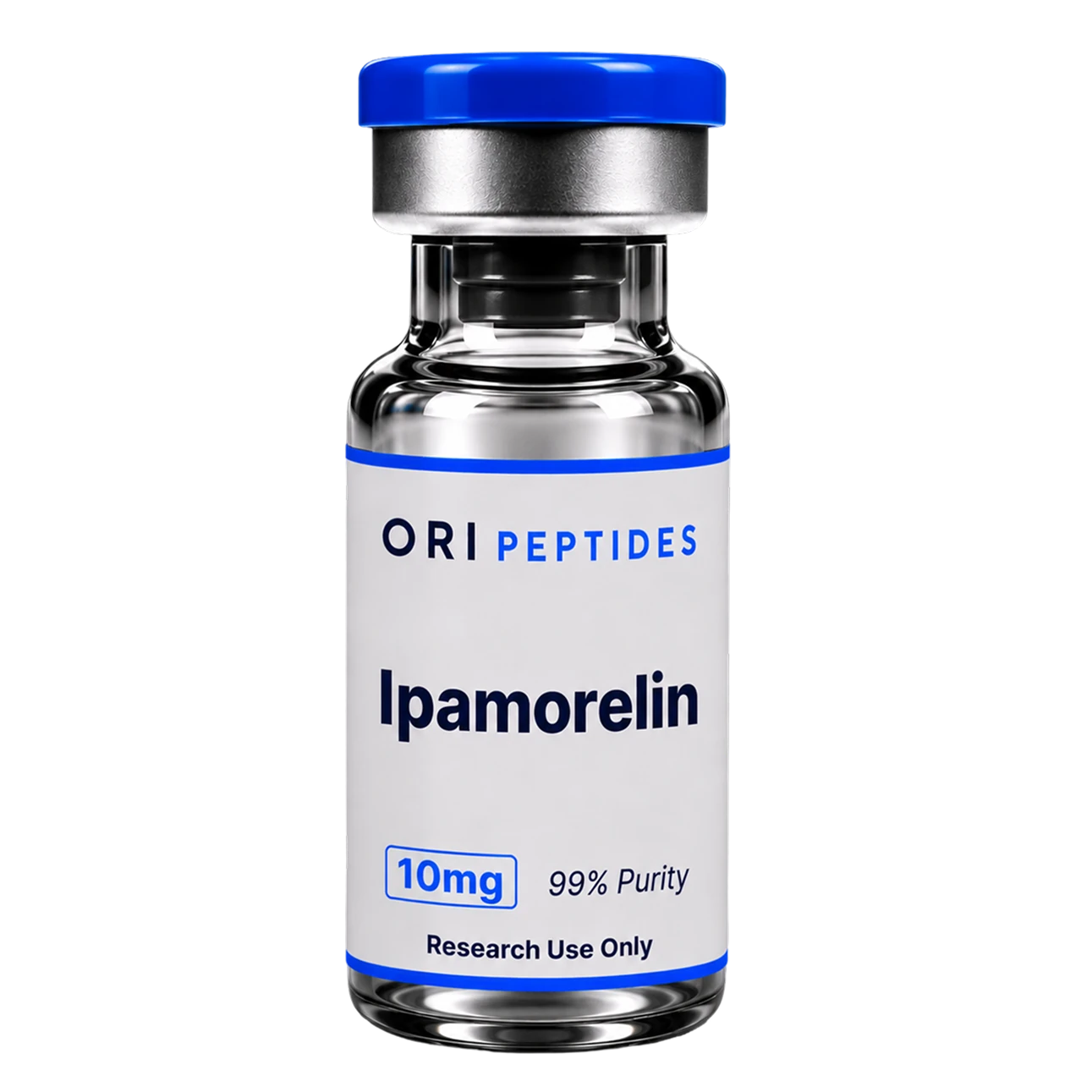
HORMONE THERAPY
Ipamorelin
Reconstitution Step by Step
Turning freeze-dried ipamorelin powder into a usable liquid follows the same general process used across peptide research material, with a bit of arithmetic to get the concentration right.
- Start with the vial’s labeled strength. Research vials are typically labeled in milligrams of peptide per vial, and that number, along with how much liquid is added, is what determines the final concentration.
- Add bacteriostatic water slowly, down the side of the vial. Bacteriostatic water is sterile water with a small amount of preservative added, and adding it quickly or straight onto the powder can cause foaming or damage the peptide. Letting it run down the inside wall of the vial and swirling gently, rather than shaking, helps the powder dissolve cleanly.
- Work out the concentration before drawing anything up. A peptide calculator takes the vial strength and the water volume added and returns the concentration directly, which is more reliable than doing the division by hand. As an example, using the 0.03 mg per kg dose from the one published human trial, a hypothetical 70 kg reference weight works out to about 2.1 mg per dose. At a reconstituted concentration of 2.5 mg per mL, that would be roughly 0.84 mL, a figure the calculator confirms directly rather than requiring a guess.
- Let it dissolve fully before storing or drawing up. Gently swirling, rather than shaking, gives the powder time to go fully into solution, and the vial should look clear rather than cloudy once mixing is complete.
Storage and Stability
- Freeze-dried powder needs cold, dark storage. Unreconstituted ipamorelin should stay refrigerated or frozen and out of direct light until it is mixed, the same baseline handling used across most peptide research material.
- A short half-life is a different concept from shelf stability. The two-hour figure covered earlier describes what happens once ipamorelin is inside the body, and has nothing to do with how long a mixed vial stays stable in the refrigerator, which depends on time and temperature, not on how fast the body processes the compound.
- Once mixed, the clock starts. Reconstituted ipamorelin should be kept refrigerated and used within the window stated on the product’s own documentation, since dissolving the powder into liquid makes it far more sensitive to temperature and time than the freeze-dried form.
- Repeated freeze-thaw cycles are worth avoiding. Pulling a reconstituted vial in and out of the refrigerator repeatedly, or letting it sit at room temperature for extended periods, is a common way research material loses potency before its labeled window is up.
Handling Notes
- Keeping everything clean matters throughout. Wiping the vial top with alcohol before each draw and using a fresh needle each time reduces the chance of introducing germs into a vial that may be used across multiple research sessions.
- Avoid shaking hard at every stage. Peptides are proteins, and shaking them hard can cause them to clump together or break down, which is why every mixing step described here calls for a gentle swirl instead.
- Label vials as they are mixed. Recording the date of reconstitution directly on the vial makes it easy to track the storage window without relying on memory.
- Keep the syringe’s dead space in mind. Standard syringes retain a small amount of liquid in the needle and hub after the plunger is fully depressed, which can throw off a carefully calculated volume if it is not accounted for.
Common Mixing Mistakes
- Guessing at concentration instead of calculating it. Skipping the math and eyeballing how much liquid to add is one of the most common reasons two people report different results from what should be the same research material.
- Shaking instead of swirling. Shaking hard introduces air bubbles and physical stress that can damage the peptide, even though it feels like the faster way to get the powder to dissolve.
- Leaving a mixed vial at room temperature. Once reconstituted, ipamorelin is far less stable than in its freeze-dried form, and leaving it out for convenience shortens how long it stays usable.
- Ignoring the syringe’s dead space. Not accounting for the small volume retained in the needle and hub after each draw compounds into a meaningfully different total dose over repeated uses.
This content is provided for Research Use Only (RUO). The compounds discussed are not drugs, dietary supplements, foods, or cosmetics, and are not intended for human or animal consumption, diagnostic use, or therapeutic use of any kind. They have not been evaluated by the FDA for safety or efficacy in humans. Any research use must be conducted by qualified professionals in a controlled laboratory environment, in accordance with all applicable institutional, local, and federal regulations.
FAQ
Is ipamorelin approved by the FDA?
No. Ipamorelin has not been approved by the FDA for any use. The furthest it got in human testing was an early stage trial to see if it helped patients recover from surgery, and it was not carried forward after that trial.
What does research show about ipamorelin’s benefits?
Ipamorelin is documented to raise growth hormone levels in both animal and human contexts, without meaningfully raising cortisol or prolactin the way older compounds in its class do. Effects like weight gain and bone growth have been recorded in animal studies, but the one trial that tested a human outcome directly looked at surgical recovery, not these other effects.
What are the known side effects of ipamorelin?
Its trial in patients recovering from bowel surgery reported adverse events slightly less often in the ipamorelin group than in the placebo group, suggesting good tolerability, though safety data outside that specific surgical setting is thin, since human testing is limited to that trial and one earlier short dose-finding study.
What dose was used in the one published human trial?
Patients in that trial received 0.03 milligrams of ipamorelin for every kilogram of body weight, given through an IV drip, twice daily, for up to seven days after bowel surgery. That dose and delivery method were specific to that surgery recovery study, not a general research plan.
Is there an official ipamorelin dosing schedule for research use?
No. Since ipamorelin has never been approved for any use, there is no official dosing schedule, and the one published human dose does not translate into a general research plan.
Is ipamorelin research material legal to buy?
Research material sold for laboratory use only comes with its own rules, and these can vary, so it is worth checking directly rather than assuming.
Sources
- Wikipedia. Ipamorelin, pharmacology and development history.
- Raun K, Hansen BS, Johansen NL, Thogersen H, Madsen K, Ankersen M, Andersen PH. (1998). Ipamorelin, The First Selective Growth Hormone Secretagogue. European Journal of Endocrinology.
- Beck DE, Sweeney WB, McCarter MD, Ipamorelin 201 Study Group. (2014). Prospective, Randomized, Controlled, Proof-of-Concept Study of the Ghrelin Mimetic Ipamorelin for the Management of Postoperative Ileus in Bowel Resection Patients. International Journal of Colorectal Disease.
- Wikipedia. CJC-1295, pharmacology and development history.
- Micle D, Popovic V, Kendereski A, Macut D, Casanueva FF, Dieguez C. (1995). Growth Hormone Secretion After the Administration of GHRP-6 or GHRH Combined with GHRP-6 Does Not Decline in Late Adulthood. Clinical Endocrinology.
- Gobburu JV, Agerso H, Jusko WJ, Ynddal L. (1999). Pharmacokinetic-Pharmacodynamic Modeling of Ipamorelin, A Growth Hormone Releasing Peptide, in Human Volunteers. Pharmaceutical Research.
- Jimenez-Reina L, Canete R, De la Torre MJ, Bernal G. (2002). Chronic In Vivo Ipamorelin Treatment Stimulates Body Weight Gain and Growth Hormone Release In Vitro in Young Female Rats. European Journal of Anatomy.
Ipamorelin research material is stocked in the hormone therapy research category, with the full range available in the shop.