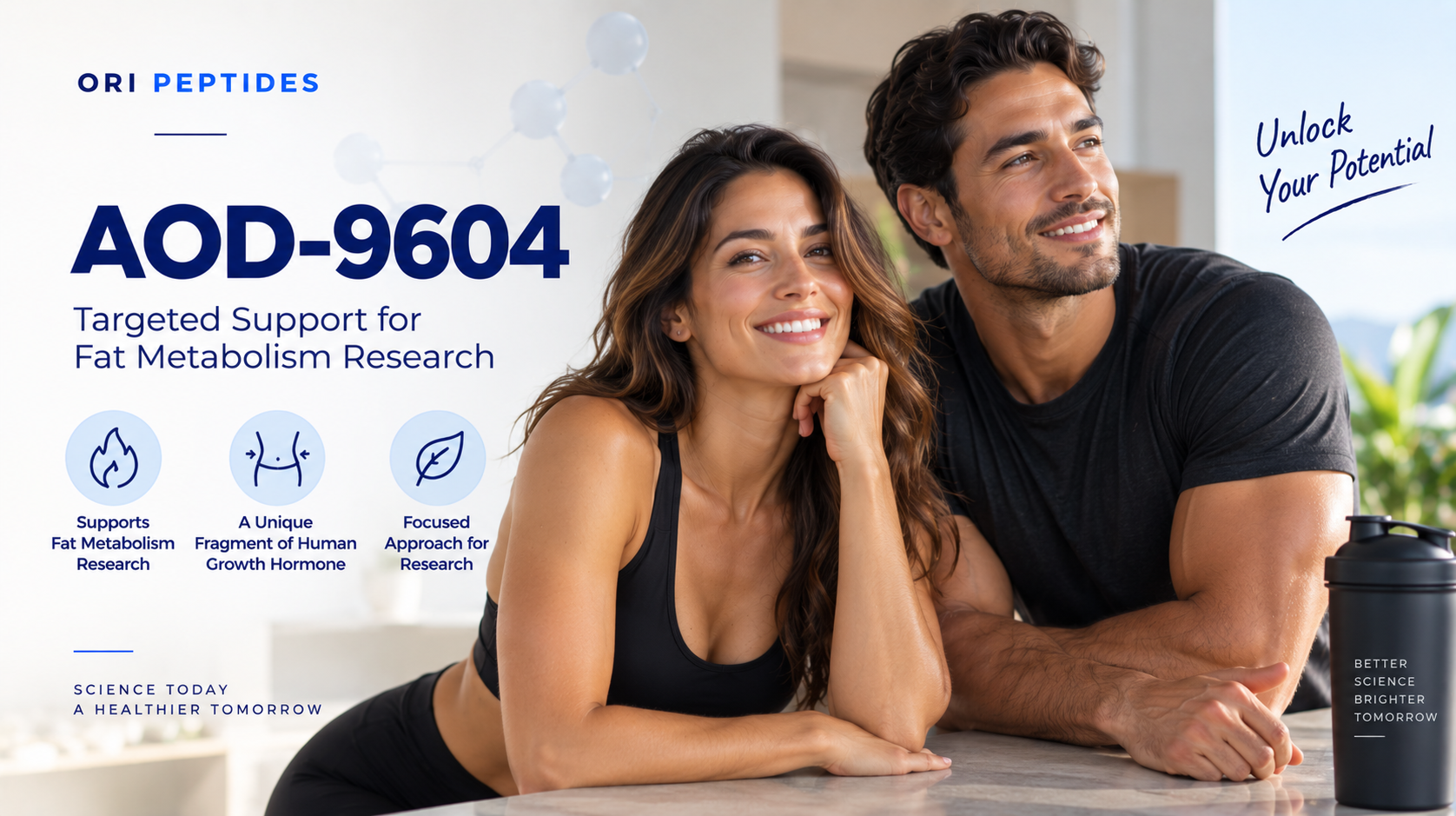
AOD-9604 has a different story than most peptides in this category. Rather than being built from scratch to lock onto one specific target in the body, it was cut directly out of the human growth hormone molecule, keeping the one piece researchers believed was doing the fat burning work. This guide covers what AOD-9604 actually is, what research has found and where that evidence stayed thin, how it compares to other peptides connected to growth hormone research, and how dosage is actually addressed for research material that was never approved for human use.
What Is AOD-9604
AOD-9604 is a small piece of human growth hormone, taken from the part scientists believe controls fat burning, a process known as lipolysis.
- A fragment, not a full hormone. AOD-9604 is made from a specific sixteen-piece stretch of the growth hormone molecule (the building blocks at positions 176 to 191), with one extra building block, called tyrosine, added at the start to help it stay stable. It is sometimes called HGH Fragment 176-191 for that reason.
- Not an approved drug. AOD-9604 has not been approved by the FDA for any use. The company that originally developed it stopped the program in 2007 after a later trial did not show strong enough results.
- Still relevant to anti-doping testing. Despite that discontinued program, AOD-9604 remains a banned substance in competitive sports and is specifically tested for in doping control, which keeps it on researchers’ radar even though it was never approved as a treatment.
- A proposed explanation, not a proven one. Early research found that AOD-9604 appeared to increase fat breakdown in mice by acting on a specific signal switch on fat cells, called a beta-3 receptor, that helps control how fat cells release energy. When researchers bred mice without that switch, AOD-9604 stopped working on them entirely, which is why scientists believe this switch plays the central role. Still, this evidence comes from mouse studies, not confirmed human data.
- A different approach than growth hormone boosters. AOD-9604 works differently than compounds like MK-677 benefits research, which push the body to release more of its own growth hormone. AOD-9604 is a piece of the hormone itself, given directly, rather than a trigger for the body’s own release, and researchers reported it did not raise IGF-1, a growth signal, the way full growth hormone treatment does.
Benefits of AOD-9604
Most of what gets described as a benefit here is a documented early research finding rather than a confirmed outcome, and it comes with an important caveat attached.
- A modest result in an early trial. One randomized trial found that participants receiving AOD-9604 lost an average of about 1.8 kg more than those receiving a placebo, an inactive comparison treatment, over twelve weeks.
- The appeal of isolating one effect. The original rationale for studying AOD-9604 separately from full growth hormone was to keep the fat metabolism effect while avoiding the broader hormonal changes, including the rise in IGF-1, that come with growth hormone itself.
- A finding that a larger trial could not confirm. A later 24 week trial found it did not work well enough, and the company originally developing it stopped the program in 2007. No larger confirming trial has followed since, so the twelve week result stands as an early signal rather than an established benefit.
- Why this matters for research framing. Because the encouraging result came from a single early trial that a bigger, longer study did not replicate, describing AOD-9604 as having confirmed fat loss benefits would overstate what the published research record actually supports.
Side Effects of AOD-9604
The public safety record for AOD-9604 is thinner and less detailed than for many peptides in this category, which is itself worth noting.
- A dedicated safety study exists. A published study specifically looked at how safe and well tolerated AOD-9604 was in humans, separate from the trials testing whether it worked for fat loss, though the detailed list of side effects from that study has not been widely published anywhere easy to find.
- No publicly documented safety signal ended the program. AOD-9604’s development was halted in 2007 because a later trial did not work well enough, not because of a reported safety problem, which is a meaningful distinction when reading its history.
- Limited data means limited certainty. With a research record concentrated in the 2000s and early 2010s and no larger modern trials, long-term human safety data for AOD-9604 remains thin compared to peptides that have been studied more recently and more extensively.
- Absence of reported problems is not proof of safety. A small, older set of trials simply has not generated the volume of safety data that would be needed to rule out uncommon effects, so this should be read as a data gap rather than a clean bill of health.
AOD-9604 Compared to Other Relevant Peptides
AOD-9604 sits alongside a couple of other peptides that connect back to the same growth hormone axis, though each one works through a different mechanism, and the weight loss figures below come from separate trials rather than a head to head comparison.
| AOD-9604 | MK-677 | Tesamorelin | |
|---|---|---|---|
| What it is | A fragment of human growth hormone (amino acids 176 to 191) | A small molecule that mimics ghrelin, the hunger hormone, to trigger growth hormone release | A lab-made copy of the hormone that tells the body to release growth hormone |
| How it works | Believed to act on a signal switch on fat cells | Triggers pulses of the body’s own growth hormone release | Stimulates growth hormone and IGF-1 release |
| Approval status | Not FDA approved, development discontinued in 2007 | Not FDA approved | FDA approved as Egrifta, for a specific medical condition |
| Typical route studied | Described as active when taken by mouth in early research | Taken by mouth | Given as a shot under the skin |
| Raises IGF-1 | No, by original design | Yes | Yes |
| Reported weight loss data | About 1.8 kg more than placebo over 12 weeks in an early trial, not confirmed by a later 24 week trial | Not studied for weight loss, and mimicking the hunger hormone is linked to increased appetite | About 14 to 18% reduction in visceral fat (the fat stored around internal organs) over 26 weeks in its approval trials, not the same as total body weight |
| Studied primarily for | Fat metabolism | Growth hormone deficiency, muscle mass, bone density, sleep | Reducing excess belly fat in a fat-buildup condition linked to HIV treatment |
Tesamorelin is the one compound in this table with an actual FDA approval, though for a specific medical condition rather than general fat loss, and its 14 to 18% figure measures fat around the internal organs specifically rather than total body weight, which is why it is listed separately from AOD-9604’s total body weight figure rather than treated as a direct match.
AOD-9604, MK-677, and Tesamorelin all connect back to the growth hormone axis in some way, but other weight loss peptides work through an entirely different system. Retatrutide, for example, targets GLP-1, GIP, and glucagon signals instead of the growth hormone pathway, and recent trials on that class have generally reported larger weight loss numbers over comparable timeframes. Because the mechanisms are so different, AOD-9604 and GLP-1 class peptides are not interchangeable options for the same research question, even though both come up in weight loss related research. More on that separate mechanism is covered in what is retatrutide, mechanism, research and uses.
Dosage
AOD-9604 does not have an established or approved human dosage, since it was never approved for any use and its original development program ended in 2007.
- No official dosing schedule exists. Because AOD-9604 is not an approved drug, there is no official label telling anyone how much to use, and the specific doses and schedules used in its original trials are not detailed in the information available today.
- Research material is not a treatment plan. Anything sold as AOD-9604 research material is intended for laboratory research by qualified professionals, not for a personal dosing schedule, so this guide will not state a number to use.
- Concentration matters more than a fixed amount. For anyone working with research material, getting the strength right after mixing the powder into liquid (a step called reconstitution) is the practical question, and a concentration calculator works that out directly rather than relying on a guess.
- Storage affects consistency. The freeze-dried powder should stay frozen or refrigerated and kept out of light, and once mixed, the solution should be refrigerated and used within the window noted on the product’s own documentation.
This content is provided for Research Use Only (RUO). The compounds discussed are not drugs, dietary supplements, foods, or cosmetics, and are not intended for human or animal consumption, diagnostic use, or therapeutic use of any kind. They have not been evaluated by the FDA for safety or efficacy in humans. Any research use must be conducted by qualified professionals in a controlled laboratory environment, in accordance with all applicable institutional, local, and federal regulations.
FAQ
Is AOD-9604 approved by the FDA?
No. AOD-9604 has not been approved by the FDA for any use, and its original development program was discontinued in 2007.
Why is AOD-9604 still tested for in sports if it was never approved?
Anti-doping programs test for compounds based on their potential effects and history in athletic contexts, not on whether a drug reached approval. AOD-9604 remains on banned substance lists despite its discontinued development.
Did AOD-9604 actually work for fat loss?
The evidence is mixed. An early twelve week trial showed a modest advantage over placebo, but a later 24 week trial showed poor enough results that development was halted, and no larger confirming trial followed.
Is there an established dosage for AOD-9604?
No. Since AOD-9604 was never approved, there is no official dosing schedule, and the exact doses and schedules used in its original trials are not detailed in the information available today.
Is AOD-9604 research material legal to buy?
Research material sold for laboratory use only comes with its own rules, and these can vary, so it is worth checking directly rather than assuming.
Sources
- Wikipedia. AOD9604, pharmacology and development history.
- Heffernan M, Summers RJ, Thorburn A, Ogru E, Gianello R, Jiang WJ, Ng FM. (2001). The Effects of Human GH and Its Lipolytic Fragment (AOD9604) on Lipid Metabolism Following Chronic Treatment in Obese Mice and Beta(3)-AR Knock-Out Mice. Endocrinology.
- Stier H, Vos E, Kenley D. (2013). Safety and Tolerability of the Hexadecapeptide AOD9604 in Humans. Journal of Endocrinology and Metabolism.
- Thevis M, Thomas A, Schanzer W. (2014). Detecting Peptidic Drugs, Drug Candidates and Analogs in Sports Doping, Current Status and Future Directions. Expert Review of Proteomics.
- Wikipedia. Tesamorelin, pharmacology and regulatory history.
- Egrifta (tesamorelin) prescribing information, visceral adipose tissue reduction data from pivotal trials.
AOD-9604 research material is stocked alongside related compounds in the weight loss research category, with the full range available in the shop.