
Tesamorelin dosage is one of the best documented in the peptide world, mostly because tesamorelin is also an FDA approved medication, sold as Egrifta SV and Egrifta WR. This guide breaks down what tesamorelin is, how it works, what research says about it, how it is dosed and reconstituted, and the safety points worth knowing, all in plain language rather than clinical jargon.
What Is Tesamorelin?
Tesamorelin is a lab-made version of growth hormone releasing hormone (GHRH), a natural signal that tells the brain’s pituitary gland to release growth hormone.
- What it is. A modified copy of a natural 44 amino acid hormone, changed just enough that it breaks down slower than the original in the body.
- What it is approved for. Reducing excess abdominal fat in people with HIV associated lipodystrophy, an abnormal pattern of fat gain and loss linked to HIV and its treatment.
- Brand names. Egrifta SV (daily) and Egrifta WR (weekly), both made by Theratechnologies.
- Approval history. First approved by the FDA in 2010 as Egrifta, with the weekly Egrifta WR version added in 2025.
- What it is not. A general weight loss drug, a muscle building supplement, or a product approved for anyone outside its specific HIV related indication.
How Tesamorelin Works
Tesamorelin follows a chain reaction that starts in the brain and ends in the fat cells:
- Step one, the signal. Tesamorelin mimics GHRH and binds to the GHRH receptor on the pituitary gland, the same receptor the body’s own hormone uses.
- Step two, the release. This tells the pituitary to release more growth hormone into the bloodstream.
- Step three, the downstream hormone. Growth hormone then prompts the liver to produce IGF-1 (insulin like growth factor 1), a hormone that carries out many of growth hormone’s effects on the body.
- Step four, the fat effect. Through this chain, tesamorelin is associated with breaking down fat, specifically the visceral fat that sits around internal organs rather than just under the skin.
- Not the same as ghrelin mimetics. Ipamorelin, another growth hormone related peptide covered on this site, works differently. It mimics ghrelin, the hunger hormone, and acts on a separate receptor rather than the GHRH pathway tesamorelin uses.
Benefits of Tesamorelin
Research on tesamorelin has mostly focused on its approved use, with a few studies looking beyond it. None of the following is evidence that tesamorelin works this way for a general audience outside a controlled trial.
- Visceral fat reduction. The trials that led to FDA approval reported roughly an 18 percent reduction in visceral fat compared with placebo over twelve months, the main result behind its approved use.
- Body composition. Beyond visceral fat, a later analysis of trial data in the same HIV patient population found increases in skeletal muscle area and density, consistent with tesamorelin’s effect on the growth hormone axis. Muscle related research in people without HIV is limited.
- Cognitive function, a research question. A 2012 controlled trial examined whether the same GHRH pathway affected cognitive performance in older adults, including some with mild cognitive impairment, and reported favorable results on certain measures. This is a research finding, not an approved use.
- What it does not show. Tesamorelin is not shown to be a general fat loss or muscle building aid outside its studied population, and the research does not support broader wellness or performance claims.
Tesamorelin Dosage
Tesamorelin’s dosing and reconstitution details come from its approved product labeling, which is a more thorough public record than most peptides have.
- The approved dose. Egrifta SV is dosed at 1.4 mg, delivered as 0.35 mL of reconstituted solution, injected subcutaneously once daily. Egrifta WR is a separate formulation dosed once weekly.
- Reconstitution basics. Research material typically arrives as a freeze-dried powder mixed with a liquid before use, commonly bacteriostatic water, a sterile saline solution that resists bacterial growth across repeated draws from the same vial. The approved product instead uses plain Sterile Water for Injection, since it is built for a single dose rather than repeated draws.
- Getting the ratio right. Vial size and target concentration determine how much diluent to add, a calculation covered step by step in how to reconstitute peptides and worked out directly with the peptide calculator.
- Mixing and storage. Diluent is added slowly down the side of the vial, and the vial is rolled gently rather than shaken, since shaking can damage the peptide. Freeze-dried material is more stable than the reconstituted form and should be stored away from light until it is prepared for use. The approved product’s labeling calls for the reconstituted solution to be used immediately, with any unused portion discarded, since it carries no preservative.
- Common mistakes. Skipping the concentration calculation, using a cloudy or discolored solution, and saving a reconstituted dose for later by refrigerating or freezing it are the errors that show up most often.
Hormone Therapy
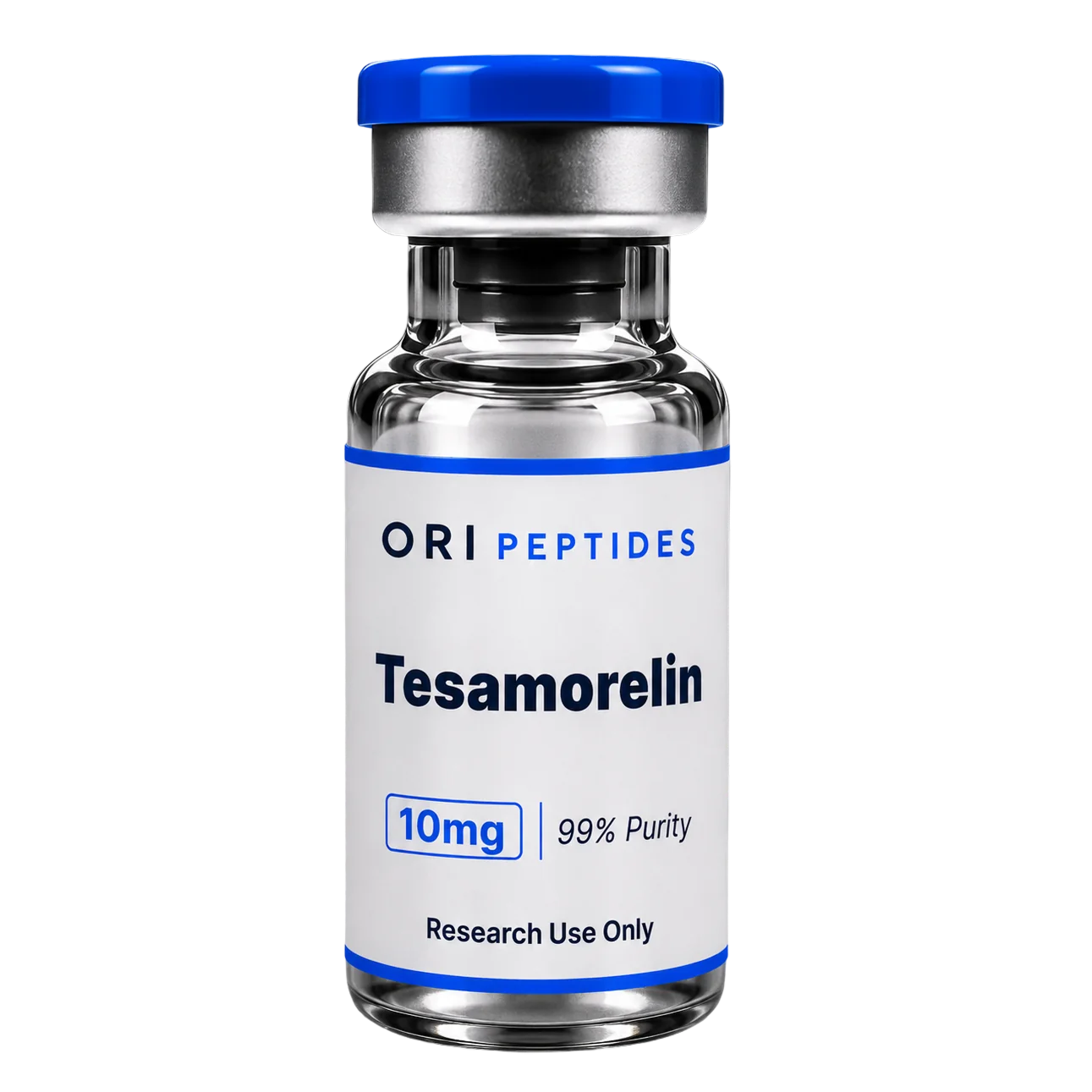
Tesamorelin 10mg
Side Effects and Safety of Tesamorelin
Tesamorelin’s safety record comes from its approved product labeling and the trials behind it, alongside general cautions that apply to research material.
- Reported more often. Depressed mood, sleep changes, night sweats, mild rash, nausea, and injection site irritation.
- Reported less often but rated more serious. Swelling in the hands, ankles, or feet, joint or muscle pain, numbness in the extremities, and higher blood sugar readings.
- Pregnancy warning. Tesamorelin’s approved labeling contraindicates use in pregnancy due to a glucose intolerance risk.
- An approved drug, an unapproved research material. The FDA approval covering tesamorelin applies to a specific formulated pharmaceutical product for a specific diagnosis. It does not extend to unformulated research material sold for laboratory use, including the tesamorelin vials stocked in the hormone therapy category.
Research Use Only. This content is provided for Research Use Only (RUO). The compounds discussed are not drugs, dietary supplements, foods, or cosmetics, and are not intended for human or animal consumption, diagnostic use, or therapeutic use of any kind. They have not been evaluated by the FDA for safety or efficacy in humans. Any research use must be conducted by qualified professionals in a controlled laboratory environment, in accordance with all applicable institutional, local, and federal regulations.
FAQ
What is tesamorelin?
Tesamorelin is a lab-made version of growth hormone releasing hormone, sold under the brand names Egrifta SV and Egrifta WR. It is FDA approved for reducing excess abdominal fat in people with HIV associated lipodystrophy.
Is tesamorelin the same as HGH?
No. Tesamorelin does not contain growth hormone itself. It prompts the pituitary gland to release more of the body’s own growth hormone, which is a different mechanism than injecting growth hormone directly.
How is tesamorelin different from ipamorelin?
Tesamorelin acts on the GHRH receptor, while ipamorelin mimics ghrelin and acts on a different receptor. Tesamorelin also has an FDA approved pharmaceutical use, while ipamorelin remains an unapproved research compound.
Is tesamorelin a general weight loss drug?
No. It is approved only for a specific pattern of abdominal fat linked to HIV associated lipodystrophy, not for weight loss in the general population.
Was tesamorelin studied for anything besides fat loss?
Yes. A 2012 controlled trial looked at its effect on cognitive performance in older adults, including some with mild cognitive impairment. That remains a research question rather than an approved use.
Is tesamorelin legal?
The approved pharmaceutical version is available by prescription. Unformulated research material is sold for research use only and current rules should always be checked directly rather than assumed.
Sources
- Dhillon S (2011). Tesamorelin, a Review of Its Use in the Management of HIV-Associated Lipodystrophy. Drugs.
- Falutz J, Potvin D, Mamputu JC, et al. (2010). Effects of Tesamorelin, a Growth Hormone-Releasing Factor, in HIV-Infected Patients With Abdominal Fat Accumulation, a Randomized Placebo-Controlled Trial With a Safety Extension. Journal of Acquired Immune Deficiency Syndromes.
- Ferdinandi ES, Brazeau P, High K, et al. (2007). Non-Clinical Pharmacology and Safety Evaluation of TH9507, a Human Growth Hormone-Releasing Factor Analogue. Basic and Clinical Pharmacology and Toxicology.
- Baker LD, et al. (2012). Effects of Growth Hormone-Releasing Hormone on Cognitive Function in Adults With Mild Cognitive Impairment and Healthy Older Adults, Results of a Controlled Trial. Archives of Neurology.
- Theratechnologies Inc. Egrifta SV and Egrifta WR (Tesamorelin for Injection) Prescribing Information.
Research compounds referenced above, including tesamorelin, are stocked in the hormone therapy category, alongside the rest of the shop.