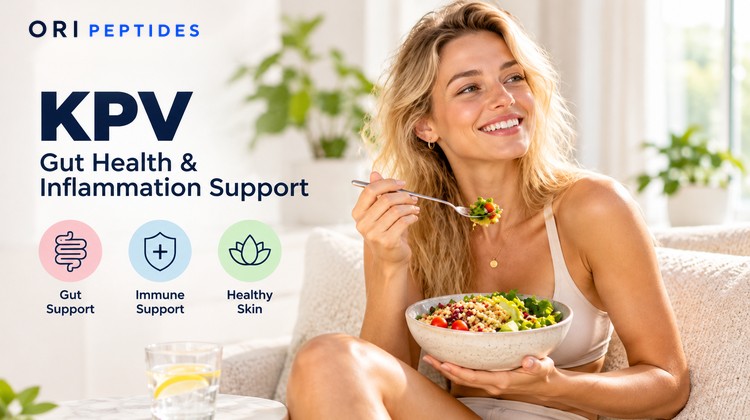
KPV is a three-amino-acid peptide studied in research on inflammation, gut health, immune response, and skin conditions. It is the last three amino acids of alpha-MSH, a hormone involved in inflammatory signaling.
KPV dosage is one of the most searched questions about it. This guide explains what KPV is, what published lab studies found, how it compares with BPC-157, and which KPV amounts appear in the papers. It describes research only and is not advice for any person. For a deeper look at the biology, see the KPV peptide research guide.
Many online pages about KPV come from telehealth companies, pharmacy brands, and wellness publishers. Those pages often list benefits, doses, and who should use it. This guide leaves out any claim that could not be traced to a published paper.
What Is KPV Peptide?
KPV is made of just three amino acids, lysine (K), proline (P), and valine (V). A peptide is a short chain of amino acids, like a very small piece of a protein. KPV is the last three letters of alpha-MSH, a natural hormone best known for skin color and for calming inflammation.
A 2010 review explained why this small piece draws interest. The full hormone has many effects, including darkening the skin, which limited its use in research on inflammation. KPV keeps almost all of the hormone’s anti-inflammatory activity in lab tests, without the skin-darkening effect. Because it is so short, it is also cheap to make and easy to study.
What Does KPV Peptide Do? Research Findings and Proposed Uses
Most KPV work asks one question, which is whether it can quiet inflammation. Inflammation is the body’s response to injury or irritation, and too much of it is behind many chronic conditions. The table gives the short version. Below it, each area is explained in plain words, with what was tested, what was seen, and what the limit is.
| Area | Tested in | What was seen |
|---|---|---|
| Gut inflammation | Human gut cells and lab models of colitis | Lower inflammation signals, less weight loss, lower colon markers |
| Colon tumor growth | Lab models | Less inflammation-linked tumor growth, only when the PepT1 transporter was present |
| Skin | Human skin cells in a dish | Better cell survival and a lower IL-1 beta signal after fine dust |
| Airways | Human airway lining cells | Lower inflammation signals and fewer calls for immune cells |
| Mouth sores | Lab model, KPV held in a gel | Better weight recovery and lower inflammation signals |
| Germs | Dish tests | Slowed growth of one bacterium and one yeast |
| Allergy cells | Human blood cells | No effect seen |
Gut inflammation. This is the best-studied area. In a 2008 study, human gut cells and immune cells were irritated with an inflammation trigger, and adding KPV at 10 nM lowered the activity of the NF-kB and MAP kinase inflammation pathways and cut the signal IL-8, which calls immune cells to a site. The same study used two lab models of colitis, meaning swollen, irritated colon lining, each started a different way. KPV in drinking water led to less weight loss, lower colon inflammation scores, and about 50% and 30% lower levels of MPO, an enzyme released by inflammatory immune cells that researchers use to measure how much inflammation a tissue has. KPV alone, with no trigger, did not change the baseline markers. A separate 2008 study saw earlier recovery of body weight and fewer inflammatory cells in two more colitis models. What it means in plain words is that different groups saw similar results in several gut models. The limit is that all of this is cells and lab models, and the 100 µM amount was picked from earlier work with the full hormone.
Colon tumor growth. Long-lasting colon inflammation can raise the chance of tumors, so a 2016 study looked at this link. Lab models with extra PepT1 had more and larger tumors, and models with PepT1 removed had fewer. KPV reduced tumor development in normal models, and it had no such effect in models that lacked PepT1, which suggests the transporter is how KPV gets in. The same paper found more PepT1 in colon samples from people with colorectal cancer. The limit is that this was a chemically triggered lab model, so it says nothing yet about people.
Skin. Fine dust in the air can damage skin cells and cause inflammation. In a 2025 study, human skin cells (the outer-layer type, called keratinocytes) were exposed to fine dust, which lowered their survival. KPV at 50 µg/mL helped restore survival and lowered IL-1 beta, an inflammation signal. The authors linked this to less oxidative stress, which is damage from unstable molecules, and to calmer MAPK and NF-kB pathways. The limit is that this was skin cells in a dish and one type of dust. A 2017 study also showed that plain KPV barely passes through human skin samples, so reaching real skin would need special delivery methods.
Airways. In a 2012 study, human airway lining cells were irritated with TNF-alpha or with RSV, a common respiratory virus. KPV lowered NF-kB activity, MMP-9 activity (an enzyme linked to tissue breakdown), and the signals IL-8 and eotaxin that call immune cells in. The drop grew with the amount of KPV used. The limit is that this was one type of cell in a dish.
Mouth sores. A 2021 study put KPV into a gel made to stick to the inside of the mouth, and tested it in a lab model of mouth sores caused by chemotherapy. The gel stayed in place for about 7 hours, KPV kept its activity inside it, and the lab model showed better food intake, better weight recovery, lower IL-1 beta and TNF-alpha signals, and a higher level of IL-10, a calming signal. The limit is that the gel also contained another compound with germ-fighting activity, so the results belong to the whole gel and not to KPV alone.
Germs. A 2000 lab study found that KPV slowed the growth of Staphylococcus aureus, a common skin bacterium, and Candida albicans, a yeast. The limit is that these were dish tests and not infections.
Immune and allergy cells. Here the picture is mixed. A 2010 review named bowel and skin diseases, allergic asthma, and arthritis as areas worth testing, which is a suggestion for future research and not a result. Then a 2012 study found that the full alpha-MSH hormone calmed allergy-related blood cells called basophils in a dish, while KPV did not. So not every effect of the hormone carries over to its small piece.
Proposed uses with no paper behind them. Some commercial pages also list joint comfort, general recovery, and mood. No paper found for this guide tests KPV for those uses.
The key limit is the type of evidence. Every finding above comes from cells, lab models, or human skin samples in a lab. A search of PubMed, the main medical research database, found no human trial of KPV.
See also: Peptides for Skin and What Current Research Examines
How It Works
Inside a cell, inflammation is switched on by a protein group called NF-kB. Think of it as a master switch. When a cell is irritated, NF-kB moves into the cell’s control center, the nucleus, and turns on genes that make inflammation signals.
KPV appears to interfere with this switch. A 2012 study in human airway cells found that KPV entered the nucleus and blocked part of NF-kB from getting in. The 2008 gut work found that KPV lowered NF-kB activity and the signal IL-8 in human gut cells.
KPV does not work the way the full hormone does. A 2003 study found that KPV acts differently from alpha-MSH and does not use the usual melanocortin receptors, the docking spots the hormone normally uses. The 2010 review adds that the exact signaling path is still unknown.
In the gut, KPV has a helper. The 2008 work found that PepT1, a transporter that normally moves small pieces of food protein into gut cells, also carries KPV. PepT1 is found in the small intestine, and it rises in the colon during inflammatory bowel disease. This helps explain why a three-letter peptide could act in the gut after being given by mouth in lab models.
KPV vs. BPC-157
KPV and BPC-157 are often mentioned together, but they are different compounds with different research histories.
| Feature | KPV | BPC-157 |
|---|---|---|
| What it is | 3 amino acids, the tail end of alpha-MSH | 15 amino acids, based on a protein found in gastric juice |
| Main research area | Inflammation in gut, skin, and airway models | Repair of tendon, muscle, bone, and gut lining in lab models |
| Main evidence | Cells, lab models, human skin samples | Mostly lab models |
| Human data | None found in PubMed | Very limited, from a few small pilot reports |
| Known limits | Breaks down in warm liquid, barely crosses skin | Short half-life of under 30 minutes, no clinical safety data |
The difference in aim is the simplest way to see them apart. KPV research centers on calming inflammation signals. BPC-157 research centers on repair, including blood vessel growth, in injured tissue.
The amount of human data is also different, although neither has much. A 2025 systematic review of BPC-157 in sports medicine found 36 studies, of which 35 were lab studies and 1 was a small human report. Another 2025 review counted three small human pilot studies. Both reviews said that clinical safety data are missing and that large trials are needed. For KPV, the search for this guide found no human study at all. Anyone comparing the two should keep in mind that the BPC-157 literature is larger but still mostly lab work, and that a larger literature does not by itself show how a compound acts in people.
For BPC-157 detail, see the BPC-157 dosage research guide and the BPC-157 side effects guide.
See also: BPC-157 Benefits, What the Research Shows
INJURY AND RECOVERY
BPC-157
KPV Peptide Dosage
The first thing to know is what is missing. None of the papers reviewed gives a KPV dosage for people, and no human dosing trial turned up in the search. Dosing numbers on commercial pages are usually extrapolated from lab work or from general practice with other peptides. Every amount below comes from cells in a dish, lab models, or human skin samples in a lab, so these figures describe experiments and are not instructions.
| Study | Setting | KPV amount | What was seen |
|---|---|---|---|
| 2008 gut cell study | Human gut and immune cells in a dish | 10 nM, with an inflammation trigger | Lower activity of the NF-kB and MAP kinase inflammation pathways, and less IL-8 |
| 2008 colitis study | Lab models of colitis | 100 µM in drinking water during the test, which ran 8 days in one model and 2 days in the other | Less weight loss, lower colon inflammation markers, and about 50% and 30% less of the inflammation enzyme MPO |
| 2017 skin study | Human skin samples in a lab | Delivered by microneedles, a mild electric current, or both | Almost none passed through skin by simple diffusion |
| 2025 skin cell study | Human skin cells in a dish | 50 µg/mL | Restored cell survival and lowered IL-1 beta after exposure to fine dust |
Here is how to read the units. A nanomolar amount (nM) is one billionth of a mole per liter, and a micromolar amount (µM) is one millionth. KPV weighs about 342 daltons, worked out from the weights of its three amino acids. On that basis, 10 nM is about 3.4 nanograms per milliliter of liquid and 100 µM is about 34 micrograms per milliliter. The 2008 paper explains that the higher 100 µM level was chosen from earlier work with the full hormone, and that the gut transporter picks up KPV even at much lower levels.
Routes tested. By mouth is the best studied route. In the 2008 colitis work, KPV was simply added to drinking water. On skin, a 2017 study of human skin samples found that simple diffusion gave less than the lowest amount the test could detect (0.01 µg/mL). Microneedles brought 4.4 micrograms per square centimeter per hour through. A mild electric current alone gave 8 times that rate, and the current together with microneedles gave 35 times that rate. Plain KPV on skin did not move through in this test. Other groups have built gels to hold KPV for colon and mouth lab models, and those are delivery experiments rather than products.
Reconstitution. Reconstitution means adding liquid to a dry powder so it becomes a solution that can be measured. Research KPV usually arrives as a freeze-dried powder in a sealed vial, and the supplier’s paperwork for a specific product comes first. The steps below match the general method in the peptide reconstitution guide. The bacteriostatic water guide explains why preserved water is used. Before starting, check the vial against its Certificate of Analysis, the lab paperwork that shows what is inside and how pure it is.
Concentration calculator. Concentration means how much peptide sits in each milliliter of liquid. The math is the milligrams in the vial divided by the milliliters of water added. The concentration calculator does this for you and avoids decimal mistakes. The table shows the idea for a 5 mg vial, used here only as an example.
| Water added | Final strength | What that means |
|---|---|---|
| 1 mL | 5 mg per mL | Most concentrated |
| 2 mL | 2.5 mg per mL | Medium |
| 2.5 mL | 2 mg per mL | Easy to measure |
| 5 mL | 1 mg per mL | Most diluted |
More water means a weaker mix, not less peptide. The total amount in the vial never changes.
The mixing steps.
- Lay out everything first, then wipe the rubber tops of both vials with alcohol.
- Settle the water amount before touching the vial.
- Draw the water and clear any air bubbles.
- Add the water slowly, letting it run down the inside wall of the vial instead of hitting the powder.
- Swirl gently and never shake. A 2017 review in Interface Focus lists shaking, temperature, concentration, acidity, and contact with surfaces among the things that can make peptides clump.
- Check that the liquid looks clear. If it looks cloudy or has particles, do not keep using it.
- Label the vial with the date and the final concentration, then refrigerate it right away.
Storage and stability. No paper reviewed gives a tested shelf life for KPV mixed in water, so no number is given here. A 2015 study showed that KPV breaks down under acid, alkali, and peroxide stress into a ring-shaped by-product called lys-pro-diketopiperazine. Authors of a 2021 gel study described plain KPV solution as unstable in the lab colon model, and showed that a gel kept it active after 2 hours at body temperature. After mixing, the usual lab habits are to refrigerate, keep the vial out of direct light, and avoid repeated freezing and thawing. Record the vial lot, the date mixed, the water used, and the final concentration, so any result can be traced.
These notes describe general laboratory habits and are not a procedure for any person.
See also: Peptide Reconstitution Ratios & How to Calculate Them
Who Is (and Is Not) a Candidate for KPV Research?
This question comes up a lot online, and it needs a careful answer. Some commercial pages list types of people who might be candidates for KPV, usually based on symptoms. Those lists do not come from KPV trials, because none were found, so this guide does not repeat them.
In research terms, the candidates are projects that fit the kind of evidence that exists. KPV is a reasonable subject for labs that study inflammation signals in gut, skin, or airway cells, labs that test ways to deliver short peptides through the gut or skin, and teams that check how peptides break down over time.
KPV is not a good fit for projects that need things the papers do not yet supply. That includes work that needs a human-tested dose, a measured safety record in people, a tested shelf life for mixed solutions, or proof that an effect seen in a dish carries over to a whole body. It is also a poor fit for any project that cannot confirm the purity and identity of the material with a Certificate of Analysis.
This guide does not describe who should or should not use KPV for their own health. That question belongs with a licensed clinician and is outside the scope of laboratory research.
What Women Should Know About the KPV Peptide
The short answer is that the research does not say anything specific about women. A PubMed search combining KPV with the words female, women, sex, pregnancy, and human found no KPV study that reports results by sex or tests KPV in pregnancy or breastfeeding. The cell and skin work used human cells and skin samples, and the colitis work used lab models, but none of these papers compares results between women and men.
Some commercial pages link KPV to symptoms that are common in midlife, such as slow skin healing, gut bloating, and joint aches, and tie them to changing hormones. The papers reviewed do not test KPV for any of those symptoms, and none looks at how KPV interacts with estrogen or other hormones.
For research teams, the practical point is that sex-based differences in KPV response remain unstudied. Studies that use KPV could record the sex of the cell source or lab model so that future reviews can look for patterns. Anyone with questions about their own health, pregnancy, or hormones should speak with a licensed clinician, since a research guide cannot answer them.
Frequently Asked Questions
What is KPV peptide?
KPV is a three-amino-acid peptide, lysine-proline-valine, taken from the end of the natural hormone alpha-MSH. It is studied mainly for its effects on inflammation in gut, skin, and airway research.
What does KPV peptide do in research?
In cells and lab models, KPV lowered inflammation signals, including in gut cells, skin cells, and airway cells. No human trial was found, so these results describe lab work only.
How does KPV work?
KPV appears to block part of NF-kB, a master switch that turns on inflammation inside cells. In the gut, a transporter called PepT1 carries KPV into cells. The exact signaling path is still unknown.
How is KPV different from BPC-157?
KPV has 3 amino acids and is studied for calming inflammation. BPC-157 has 15 amino acids and is studied for tissue repair. Both are mostly studied in cells and lab models, and human data are very limited for BPC-157 and absent in the search for KPV.
What KPV dosage appears in research?
Lab studies used 10 nM in gut cell work, 100 µM in drinking water for colitis lab models, and 50 µg/mL in skin cell work. No human dose appears in the papers reviewed, and these figures are not instructions.
How is KPV reconstituted?
Bacteriostatic water is added slowly to the freeze-dried powder, the vial is swirled gently, and it is labeled and refrigerated. Concentration is the milligrams in the vial divided by the milliliters of water added, and the concentration calculator can do the math.
Is there research on KPV and women?
No KPV study found for this guide reports results by sex or tests KPV in pregnancy. The research does not say whether KPV acts differently in women.
How long does mixed KPV last?
No tested shelf life for mixed research KPV appears in the papers reviewed. A 2015 study showed that KPV breaks down under acid, alkali, and peroxide stress, so the supplier’s paperwork is the best reference.
Key Takeaways
- What it is. KPV is a three-amino-acid peptide taken from alpha-MSH and studied for inflammation in gut, skin, and airway research.
- What was found. Cells, lab models, and human skin samples showed lower inflammation signals, and no human trial was found.
- How it works. KPV appears to block a master inflammation switch called NF-kB, and a gut transporter called PepT1 carries it into cells.
- Versus BPC-157. KPV is studied for inflammation and BPC-157 for tissue repair, and both rest mainly on lab work.
- Dosage. Published amounts come from cells, lab models, and skin samples, with 100 µM in drinking water being the main oral figure, and no human dose is given in the papers reviewed.
- Stability. No tested shelf life exists for mixed KPV, and the papers show it can break down under stress and in warm liquid.
- Women. No KPV study found reports results by sex or in pregnancy.
Research Use Disclaimer
This content is provided for Research Use Only (RUO). The compounds discussed are not drugs, dietary supplements, foods, or cosmetics, and are not intended for human or animal consumption, diagnostic use, or therapeutic use of any kind. They have not been evaluated by the FDA for safety or efficacy in humans. Any research use must be conducted by qualified professionals in a controlled laboratory environment, in accordance with all applicable institutional, local, and federal regulations.
Sources
- Dalmasso G, Charrier-Hisamuddin L, Nguyen HT, et al. PepT1-mediated tripeptide KPV uptake reduces intestinal inflammation. Gastroenterology. 2008.
- Kannengiesser K, Maaser C, Heidemann J, et al. Melanocortin-derived tripeptide KPV has anti-inflammatory potential in models of inflammatory bowel disease. Inflamm Bowel Dis. 2008.
- Viennois E, Ingersoll SA, Ayyadurai S, et al. Critical role of PepT1 in promoting colitis-associated cancer and therapeutic benefits of the anti-inflammatory PepT1-mediated tripeptide KPV. Cell Mol Gastroenterol Hepatol. 2016.
- Getting SJ, Schioth HB, Perretti M. Dissection of the anti-inflammatory effect of the core and C-terminal (KPV) alpha-melanocyte-stimulating hormone peptides. J Pharmacol Exp Ther. 2003.
- Brzoska T, Bohm M, Lugering A, Loser K, Luger TA. Terminal signal, anti-inflammatory effects of alpha-melanocyte-stimulating hormone related peptides beyond the pharmacophore. Adv Exp Med Biol. 2010.
- Land SC. Inhibition of cellular and systemic inflammation cues in human bronchial epithelial cells by melanocortin-related peptides, mechanism of KPV action and a role for MC3R agonists. Int J Physiol Pathophysiol Pharmacol. 2012.
- Bohm M, Apel M, Sugawara K, et al. Modulation of basophil activity, a novel function of the neuropeptide alpha-melanocyte-stimulating hormone. J Allergy Clin Immunol. 2012.
- Cutuli M, Cristiani S, Lipton JM, Catania A. Antimicrobial effects of alpha-MSH peptides. J Leukoc Biol. 2000.
- Shao W, Chen R, Lin G, et al. In situ mucoadhesive hydrogel capturing tripeptide KPV, the anti-inflammatory, antibacterial and repairing effect on chemotherapy-induced oral mucositis. Biomater Sci. 2021.
- Pawar K, Kolli CS, Rangari VK, Babu RJ. Transdermal iontophoretic delivery of lysine-proline-valine (KPV) peptide across microporated human skin. J Pharm Sci. 2017.
- Pawar KR, Mulabagal V, Smith F, et al. Stability-indicating HPLC assay for lysine-proline-valine (KPV) in aqueous solutions and skin homogenates. Biomed Chromatogr. 2015.
- Sun J, Xue P, Liu J, et al. Self-cross-linked hydrogel of cysteamine-grafted gamma-polyglutamic acid stabilized tripeptide KPV for alleviating TNBS-induced ulcerative colitis. ACS Biomater Sci Eng. 2021.
- Sung J, Ju SY, Park S, et al. Lysine-proline-valine peptide mitigates fine dust-induced keratinocyte apoptosis and inflammation by regulating oxidative stress and modulating the MAPK/NF-kB pathway. Tissue Cell. 2025.
- Zapadka KL, Becher FJ, Gomes Dos Santos AL, Jackson SE. Factors affecting the physical stability (aggregation) of peptide therapeutics. Interface Focus. 2017.
- Vasireddi N, Hahamyan H, Salata MJ, et al. Emerging use of BPC-157 in orthopaedic sports medicine, a systematic review. HSS J. 2025.
- McGuire FP, Martinez R, Lenz A, Skinner L, Cushman DM. Regeneration or risk? A narrative review of BPC-157 for musculoskeletal healing. Curr Rev Musculoskelet Med. 2025.
- Jozwiak M, Bauer M, Kamysz W, Kleczkowska P. Multifunctionality and possible medical application of the BPC 157 peptide, literature and patent review. Pharmaceuticals. 2025.
Explore the injury and recovery research category for related research compounds, and use the concentration calculator for concentration math. For related reading, see the KPV peptide research guide, the BPC-157 dosage research guide, the thymosin alpha 1 guide, and the peptide reconstitution guide.