Tools & Trust · Research use only
Peptide reconstitution calculator for mg to mL and U-100 units
Three numbers, one formula. Divide the vial strength (mg) by the BAC water added (mL) to get concentration. Divide a target dose by that concentration to get draw volume. Multiply the draw volume by 100 to read it on a U-100 syringe. The same three steps work for any vial, any strength, any syringe.
Most reconstitution calculators stop at a single concentration number. This one carries the same three-step math through to the actual syringe reading, checks it against a 0.3 mL, 0.5 mL, and 1 mL barrel at once, and shows every intermediate figure so you can verify the arithmetic yourself rather than trust a black box. Built and maintained by ORI Peptides for anyone working through peptide vial math by hand.
01Example peptide dosage table
Four vial and BAC water combinations chosen to make a specific point, doubling the vial strength while holding the water volume fixed doubles the concentration, and holding the vial strength fixed while changing the water volume moves the concentration the other way. Seeing both directions side by side is what makes the three-step method click, rather than memorizing any single row as a rule. These are worked reference figures for illustrating the math, not a recommendation, always confirm against the strength and instructions printed on your own vial.
| Vial | BAC water | Concentration | Dose | Draw | U-100 units |
|---|---|---|---|---|---|
| 5 mg | 2 mL | 2.5 mg/mL | 0.5 mg | 0.20 mL | 20 units |
| 5 mg | 5 mL | 1 mg/mL | 0.5 mg | 0.50 mL | 50 units |
| 10 mg | 2 mL | 5 mg/mL | 1 mg | 0.20 mL | 20 units |
| 10 mg | 10 mL | 1 mg/mL | 1 mg | 1.00 mL | 100 units |
02How to calculate peptide reconstitution
Three steps, done in this order, convert any vial and BAC water combination into the exact volume to draw. Doing them out of order, or skipping straight to a remembered draw volume from a different vial, is where most avoidable mistakes creep in.
1Work out the concentration
Divide the peptide amount in the vial (mg) by the BAC water you added (mL). This number is fixed for the life of the vial, it does not change as the vial empties.
A 5 mg vial with 2 mL of water gives 5 ÷ 2 = 2.5 mg/mL.
2Work out the draw volume
Divide your target dose (mg) by the concentration (mg/mL) from step one. This is the number of milliliters that actually needs to enter the syringe barrel.
A 1 mg dose at 2.5 mg/mL gives 1 ÷ 2.5 = 0.40 mL.
3Convert to a syringe reading
Multiply the draw volume (mL) by 100, since a U-100 syringe marks 100 units to every milliliter. A 0.3 mL or 0.5 mL syringe uses this same U-100 scale, just with a shorter barrel and a lower total capacity, so the multiplier itself never changes.
0.40 mL × 100 = 40 units on a U-100 syringe.
03Dosage formula
These three formulas apply to any peptide vial, regardless of size, and they chain together in a fixed order, the output of one is the input to the next. U-100 is the standard insulin-syringe scale, 100 units always equals 1 mL, whether the barrel holds 0.3 mL or 1.0 mL.
Dosing in micrograms? Divide by 1,000 to convert to mg before running the first formula, not partway through. Converting the unit first, once, is what keeps a multi-step calculation from drifting off by a factor of 1,000.
04Peptide calculator tool
Enter a vial strength, a BAC water volume, and a target dose. The calculator returns concentration, draw volume, and the U-100 units to draw, updating as you type. Loaded here with a common starting example, 5 mg reconstituted in 2 mL, for a 1 mg dose.
Start with the basics
Educational and research purposes only · U-100: 100 units = 1 mL
Adjust syringe and planning settings
Tip, U-100 means 100 units = 1 mL, so 10 units = 0.1 mL, on any syringe size.
What to draw
Send the results
Email the current vial, BAC water, dose, draw amount, and U-100 units to yourself or a colleague.
05From the ORI Peptides shop
ORI Peptides supplies research-grade peptides for laboratory use, every product on this page's calculator and every product in the catalog below is intended strictly for Research Use Only. This calculator is one of the free tools ORI Peptides maintains so a researcher can check vial math before a project starts, alongside the compound-specific dosage and reconstitution pages linked throughout this site.
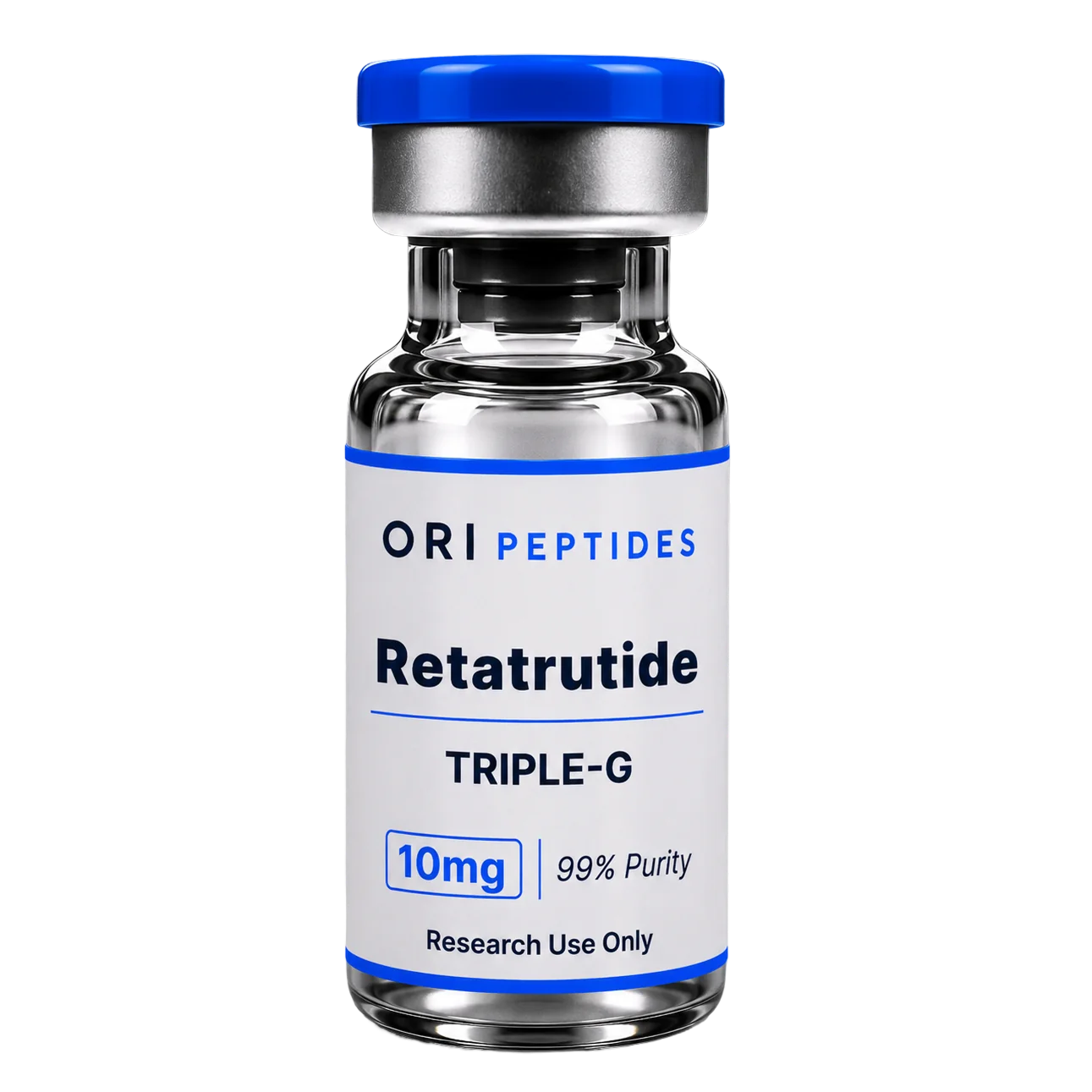
Retatrutide 10mg
Retatrutide is a synthetic peptide studied for activating three receptors at once, GLP-1, GIP, and glucagon. Researchers use this triple-action mechanism to study metabolism, energy use, and blood sugar regulation. For laboratory research only, not for human or animal use.
06Example peptide calculations
Step-by-step worked examples using common vial sizes, following the same three formulas above. Results illustrate the math only.
07Peptide reconstitution guide
Bacteriostatic water (BAC water) is the standard diluent used to reconstitute research peptides. It carries a small amount of benzyl alcohol, which is why it is used in place of plain sterile water for a vial that will be drawn from more than once.
Swab both stoppers
Swab both the peptide vial stopper and the BAC water vial stopper with a fresh alcohol swab and let them air dry fully before either needle goes in, a wet swab can carry alcohol into the vial along with the needle.
Draw the BAC water
Draw the amount of BAC water your calculation calls for into a sterile syringe, checking the barrel at eye level rather than from an angle, which is where most small measuring errors happen.
Insert and add slowly
Insert the needle through the center of the stopper and add the water slowly down the inside wall of the vial, not directly onto the powder, a fast direct stream is what causes foaming.
Swirl to dissolve
Swirl the vial gently in a slow, steady rotation until the powder is fully dissolved, the solution should end up clear with no visible particles. Do not shake it, agitation is a common cause of protein denaturation in solution.
Label and refrigerate
Label the vial with the date it was mixed and the resulting concentration, then store it refrigerated. Always follow that product’s own documentation for how long the mixed vial stays usable, this varies by compound and is not a number this page assumes.
Why bacteriostatic water instead of plain sterile water
Plain sterile water has no preservative in it, so once a vial is opened it is generally treated as single-use. Bacteriostatic water carries a small amount of benzyl alcohol, added specifically to inhibit bacterial growth across repeated needle entries. That is the practical reason it is the standard diluent for a multi-dose vial rather than a single-draw one, it is a shelf-life and contamination safeguard for the mixed solution, not a factor in the concentration math itself.
Multi-dose vials and the air-equalization habit
A sealed vial holds a slight vacuum. Drawing liquid out of it repeatedly without replacing that volume can make the stopper harder to pierce cleanly and can pull the plunger back on its own between draws. The common habit is to first draw an amount of air into the syringe equal to the BAC water you are about to inject, push that air into the vial's headspace, then invert the vial and draw the liquid back out. This equalizes the pressure and tends to make both the mixing step and every later draw noticeably smoother.
Vial overfill and why your first draw can look slightly off
Manufacturers commonly fill a lyophilized vial with a small amount of overage beyond the labeled amount, since some product is inevitably lost to the stopper, the vial wall, and the needle and hub of every syringe used to handle it. The labeled strength is what the calculator above assumes dissolves into your measured water volume. Treat the printed label and your own measured water volume as the two numbers that matter, rather than trying to account for overfill yourself, since the manufacturer has already built a margin in for exactly this reason.
Why some peptides are labeled in micrograms and others in milligrams
There is no single rule tying a compound to one unit, but a pattern shows up often enough to be worth knowing. Peptides that are typically used in very small per-dose amounts, growth hormone secretagogues are a common example, are often labeled in micrograms simply because the milligram number would otherwise be an inconveniently small decimal. Larger peptides used in comparatively larger per-dose amounts are more often labeled directly in milligrams. Either way, the calculator's mg or µg toggle above handles the conversion, the underlying three-step formula never changes.
A note on weighing precision
Because the amounts involved are small, tiny inconsistencies in how a vial is handled, air bubbles left in the syringe, water added slightly off from the intended volume, a stopper pierced repeatedly in the same spot, can shift the real-world result away from the calculated one by more than the math alone would suggest. None of this is a flaw in the formula. It is a reminder that the three-step calculation gives you the target number, and the same care that goes into reading a syringe accurately also belongs in the water-measuring and mixing steps that come before it.
08Glossary
Plain-language definitions for the terms used throughout this page.
- Peptide
- A short chain of amino acids, smaller than a full protein, commonly supplied as a freeze-dried powder in a sealed vial.
- Lyophilized
- Freeze-dried. The powder form a peptide vial ships in before any water is added.
- Reconstitution
- The act of adding a liquid diluent to a lyophilized powder to bring it into solution.
- BAC water
- Bacteriostatic water, sterile water with a small amount of benzyl alcohol added to inhibit bacterial growth across repeated draws.
- Concentration
- How much peptide sits in each milliliter of the mixed solution, expressed as mg per mL.
- Draw volume
- The amount of liquid, in mL, that needs to be pulled into the syringe to obtain a specific target dose.
- U-100 syringe
- A syringe marked on a 100-unit scale per milliliter, the standard scale on most insulin syringes.
- Dead volume
- The small amount of liquid left behind in a syringe's hub and needle after the plunger is fully depressed, part of why manufacturers build in overfill.
- Titration
- Gradually adjusting a dose upward or downward across a protocol rather than holding it fixed throughout.
- RUO
- Research Use Only, meaning a product is intended strictly for laboratory research and not for use in or on humans or animals.
09Frequently asked questions
Three formulas, chained so the answer to one feeds directly into the next. Concentration = vial (mg) ÷ BAC water (mL). Draw volume = dose (mg) ÷ concentration. U-100 units = draw volume × 100. Every worked example and every default value on this page runs through that same chain, nothing above it is a separate shortcut. Enter your own numbers in the calculator above to see it applied to your own vial.
U-100 syringes take their name from U-100 insulin, historically the standard insulin concentration the scale was built around, 100 units per milliliter. The peptide vial in front of you almost certainly has nothing to do with insulin, but the syringe barrel and its 100-unit scale are shared across both uses. 10 units equals 0.1 mL and 50 units equals 0.5 mL either way, multiply any draw volume in mL by 100 to get the U-100 reading.
Yes, every time. The concentration is set once, at the moment the water goes in, and a different water volume means a different concentration even if the vial and the target dose stay exactly the same. Recalculate concentration first, then draw volume from that new concentration, in that order, never the other way around.
Divide the mcg amount by 1,000, once, before any other step. For example, 250 mcg is 0.25 mg, 500 mcg is 0.5 mg, and 1,000 mcg is 1 mg. The calculator above does this conversion automatically when the µg toggle is selected, so the underlying three-step math never actually sees a microgram value.
Bacteriostatic water is sterile water with a small amount of benzyl alcohol added, which inhibits bacterial growth across repeated draws from the same vial. That is what separates it from plain sterile water, a preservative for the mixed solution, not a variable in the concentration formula itself, plain sterile water and BAC water dilute a vial to the exact same concentration for the exact same volume.
This varies by compound, and by design this page does not put a specific number on it. Reconstituted peptides are generally sensitive to warmth, light, and repeated temperature swings, which is why refrigeration and a labeled mix date are standard practice, but the actual usable window for the vial in front of you belongs in that product's own documentation, not in a generic rule of thumb.
The water volume a product's own instructions call for is chosen to land the concentration in a convenient, easy-to-draw range for that compound's typical per-dose amount. A smaller labeled dose is often paired with less water so the resulting draw volume stays easy to read on a syringe, rather than being a fixed rule that applies the same way to every vial.
Adding more water than intended lowers the concentration, so the same target dose needs a larger draw volume. Adding less water raises the concentration, so the same dose needs a smaller draw. Neither changes how much peptide is in the vial overall, only how spread out it is, always recalculate the draw volume from the water amount you actually used.
The concentration math is identical either way. The difference is shelf life across repeated draws, plain sterile water carries no preservative, so a vial mixed with it is commonly treated as single-use rather than a multi-dose vial. Always follow the specific product's own reconstitution instructions on which diluent it calls for.
All three are marked on the same idea, 100 units per milliliter, but a smaller barrel spreads that same 100-unit scale over a shorter physical length. A 0.3 mL syringe (30 units total) gives the widest, easiest to read spacing for small draw volumes, while a 1 mL syringe (100 units total) suits larger draw volumes. Pick the smallest syringe that still comfortably holds your calculated draw volume for the most precise reading.