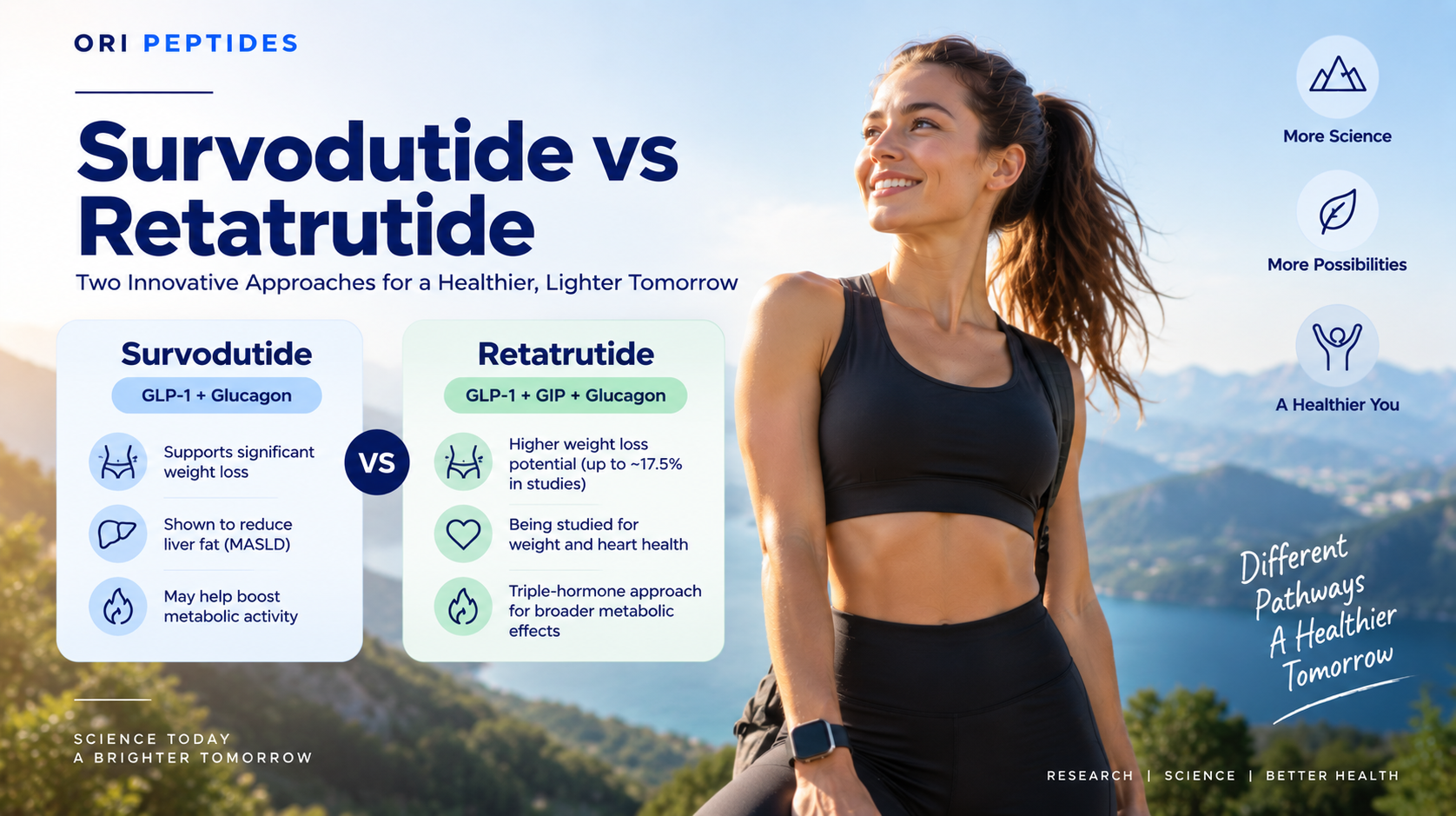
Survodutide keeps coming up in the same conversations as retatrutide and tirzepatide, though it works a little differently from both. This guide explains what survodutide actually is, how it is thought to work, what research has found so far, how it stacks up against retatrutide, and how the research material itself gets handled and stored.
What Is Survodutide?
Survodutide is built to act on two different hormone signals in the body at once, more than a single-target compound but one signal fewer than the three-signal design used in some other compounds in this category.
- A two-signal compound, not a three-signal one. Survodutide is also known by its development code, BI 456906. It is designed to act on two hormone signals at once, called GLP-1 and glucagon, instead of the three signals a compound like retatrutide is built to hit.
- Made by Boehringer Ingelheim. Survodutide comes from Boehringer Ingelheim’s metabolic research program, a different company from the ones behind the other well known compounds in this space, Eli Lilly and Novo Nordisk.
- Still being tested, not approved. Survodutide has not been approved by the FDA or any other health authority for any use. It is still going through clinical trials, currently at what is called Phase 3, generally the last round of testing before a compound could apply for approval.
- Studied for more than just weight. Beyond weight related research, survodutide has also been studied in adults with a liver condition called MASLD, short for metabolic dysfunction associated steatotic liver disease, which basically means extra fat building up in the liver. Trial data has shown less fat in the liver alongside weight loss.
How Does the GLP-1 and Glucagon Pairing Work?
The two hormones involved do different jobs in the body, and survodutide is designed to switch on both of them at the same time.
- Two hormones, two jobs. GLP-1 is a hormone linked to feeling full and to how the body releases insulin. Glucagon is better known for raising blood sugar and helping the body burn more energy. Survodutide is built to act on both signals at once.
- Sometimes called a twincretin. That is just a shorthand researchers use for a compound that switches on two gut-hormone signals at the same time, a group that also includes tirzepatide, though tirzepatide pairs GLP-1 with a different hormone called GIP instead of glucagon.
- The glucagon part is what sets it apart. Adding a glucagon effect is meant to help the body burn more energy on top of the appetite-reducing effect of GLP-1, which is a different combination than the GIP pairing used in tirzepatide.
- Still a working theory. Whether switching on these two specific signals together actually gives a meaningfully different result than a single-signal compound, or one paired with GIP instead, is still being figured out in ongoing studies.
What Does Current Research Examine?
Most of what is known about survodutide so far comes from a handful of clinical studies, not a large, settled body of evidence.
- Weight loss data. A combined look at three controlled studies, covering just over a thousand patients on weekly doses between 2.4 and 4.8 mg over four to eleven months, found people lost about seven to nine percent of their starting body weight.
- Liver fat and MASLD. A Phase 3 study called SYNCHRONIZE-MASLD looked at survodutide in adults with obesity and MASLD, and found it worked better than a placebo, an inactive dummy treatment used for comparison, at reducing both liver fat and body weight.
- Reported side effects. Stomach and digestion related issues were the most commonly reported, described in the research as usually mild and more likely at higher doses, a pattern similar to other compounds in this category.
- Still short of approval. All of this comes from clinical trials, not an approved product, and survodutide remains unapproved for any use as of this writing.
Survodutide vs Retatrutide, How They Compare
Survodutide and retatrutide get mentioned in the same breath a lot, since both go a step beyond older single or two-signal compounds, though they are not built the same way, and the trial evidence behind each one is not at the same stage yet.
| Survodutide | Retatrutide | |
|---|---|---|
| Hormone signals targeted | GLP-1 and glucagon | GLP-1, GIP, and glucagon |
| Made by | Boehringer Ingelheim | Eli Lilly |
| Approval status | Still being tested, Phase 3 | Still being tested, Phase 3 |
| Reported weight loss | About 7 to 9% over 4 to 11 months | Up to about 17.5% at 24 weeks |
| Named Phase 3 study | SYNCHRONIZE-MASLD, focused on liver fat | TRIUMPH, focused on weight and heart health |
| Research material | Sold separately for lab use | Sold separately for lab use |
The higher reported weight loss number for retatrutide lines up with its extra hormone signal. Retatrutide is designed to combine GLP-1 and GIP for the appetite reducing side with glucagon for the energy burning side, while survodutide relies on GLP-1 alone for the appetite side, paired with that same glucagon signal. The idea behind adding a third pathway is that it produces a bigger combined effect on weight than either pathway manages alone, though this is described as an open research question rather than a settled conclusion, and the same caution applies to survodutide’s two-pathway design.
It also helps to know these figures do not come from a head to head study. They come from separate trials with different doses, different follow-up lengths, and different groups of patients, so a bigger number for one compound is not proof that it works better in a matched comparison. Survodutide’s most detailed Phase 3 data released so far comes from a trial built around liver fat and MASLD, while retatrutide’s Phase 3 program is built around weight and heart health, which is one more reason the two are not an apples to apples match yet.
Weight Loss
Retatrutide 10mg
How Research Material Gets Handled and Stored
Research material sold as survodutide follows the same general handling steps used across most peptide research materials on this site.
- Mixing it follows the same general steps. Turning the freeze-dried powder into a liquid follows the same process used for other research peptides, covered in more depth in how to reconstitute peptides.
- Getting the strength right. How much liquid to add depends on the vial’s strength and the concentration a study calls for, a calculation the peptide calculator works out directly.
- Storage before and after mixing. The freeze-dried powder should stay frozen or refrigerated and kept out of light. Once it is mixed into liquid, it should be refrigerated and used within the time window listed on the product’s own documentation.
- A common mistake. Guessing at the concentration instead of calculating it, and leaving a mixed vial out at room temperature, are the two most common reasons research results turn out inconsistent.
This content is provided for Research Use Only (RUO). The compounds discussed are not drugs, dietary supplements, foods, or cosmetics, and are not intended for human or animal consumption, diagnostic use, or therapeutic use of any kind. They have not been evaluated by the FDA for safety or efficacy in humans. Any research use must be conducted by qualified professionals in a controlled laboratory environment, in accordance with all applicable institutional, local, and federal regulations.
FAQ
Is survodutide approved by the FDA?
No. Survodutide is still an unapproved compound going through Phase 3 trials, and it has not been approved by the FDA or any other health authority for any use.
How is survodutide different from tirzepatide?
Both switch on GLP-1 plus one other signal, but tirzepatide pairs it with GIP, while survodutide pairs it with glucagon, a hormone that is more about raising blood sugar and energy burn than about appetite.
Is survodutide the same as retatrutide?
No. Retatrutide targets three hormone signals, GLP-1, GIP, and glucagon, while survodutide targets two, GLP-1 and glucagon. The two come from different companies and have not been tested against each other directly.
Is survodutide research material legal to buy?
Research material sold for laboratory use only comes with its own rules, and these can vary, so it is worth checking directly rather than assuming.
Sources
- Wikipedia. Survodutide, pharmacology and clinical trial history.
- Klein T, Augustin R, Hennige AM. (2023). Perspectives in Weight Control in Diabetes, BI 456906. Diabetes Research and Clinical Practice.
- Zimmermann T, Thomas L, Baader-Pagler T, Haebel P, Simon E, Reindl W, Bajrami B, Rist W, Uphues I, Drucker DJ, Klein H, Santhanam R, Hamprecht D, Neubauer H, Augustin R. (2022). BI 456906, Discovery and Preclinical Pharmacology of a Novel GCGR/GLP-1R Dual Agonist With Robust Anti-Obesity Efficacy. Molecular Metabolism.
- Dutta D, Kamrul-Hasan AB, Joshi A, Dhall A, Nagendra L, Sharma M. (2025). Efficacy and Safety of Twincretin Survodutide, a Dual Glucagon-Like Peptide-1 and Glucagon Receptor Agonist as an Anti-Obesity and Anti-Diabetes Medication, A Systematic Review and Meta-Analysis. Indian Journal of Endocrinology and Metabolism.
- Kaplan LM, Startseva E, le Roux CW, Wharton S, Bozkurt B, et al. (2026). Survodutide in Adults With Obesity and Metabolic Dysfunction-Associated Steatotic Liver Disease, SYNCHRONIZE-MASLD, a Randomized, Double-Blind, Placebo-Controlled Phase 3 Trial. Nature Medicine.
Survodutide research material is covered here alongside what is retatrutide, mechanism, research and uses, and related compounds are stocked in the weight loss research category.