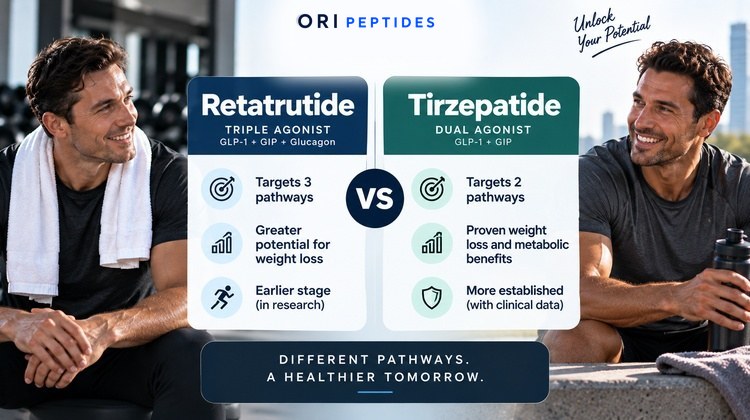
Retatrutide and tirzepatide both come up constantly in weight-loss and metabolic research, and it’s easy to lump them together since both were developed by Eli Lilly and both target overlapping hormone receptors. They aren’t the same compound, though, and they aren’t at the same stage of development either. Here is what each one is, how they work, and how researchers compare retatrutide vs tirzepatide, in plain terms. Discussion of research-grade material here is provided for Research Use Only (RUO).
What Is Retatrutide?
Retatrutide (development code LY3437943) is a synthetic peptide that belongs to a class of compounds called triple hormone receptor agonists, meaning it’s designed to act on three separate hormone signals in the body at once. It’s given as a once-weekly injection in clinical trials, is not approved by the FDA or any other health authority for any use, and is currently moving through Phase 3 clinical trials. A full explainer is covered in our retatrutide guide.
What Is Tirzepatide?
Tirzepatide is also a synthetic peptide developed by Eli Lilly, but it’s a dual hormone receptor agonist rather than a triple one, meaning it acts on two hormone signals instead of three. Unlike retatrutide, tirzepatide has completed clinical development and is an approved medicine, sold under the brand name Mounjaro for type 2 diabetes and Zepbound for chronic weight management. It’s also given as a once-weekly injection, but as an approved prescription drug rather than an investigational compound.
How Does Each One Work?
Both peptides target overlapping hormone receptors, but retatrutide adds one that tirzepatide doesn’t.
- Both target GLP-1 and GIP. These two receptors are involved in appetite regulation, insulin release after eating, insulin response, and fat metabolism.
- Retatrutide adds a third target: the glucagon receptor. This receptor is linked to energy expenditure and stored-fat metabolism, adding another pathway to the two shared with tirzepatide.
| Feature | Retatrutide | Tirzepatide |
|---|---|---|
| Receptor targets | GLP-1, GIP, and glucagon (triple agonist) | GLP-1 and GIP (dual agonist) |
| Developer | Eli Lilly | Eli Lilly |
| Regulatory status | Investigational, Phase 3 clinical trials | FDA-approved (Mounjaro, Zepbound) |
| Reported weight loss in trials | Up to about 28.3% at 80 weeks (Phase 3) | Up to about 20.9% at 72 weeks (highest studied dose) |
| Ever an approved drug? | No, investigational only | Yes, approved for diabetes and weight management |
How the Research Evidence Differs
Because tirzepatide has completed trials and years of real-world prescribing behind it, while retatrutide is still investigational, the evidence base for each looks quite different.
Tirzepatide’s research record includes the completed SURMOUNT and SURPASS trial programs, years of approved use, and documented findings for both blood sugar control and weight loss. Retatrutide’s early trial numbers are larger in some reported measures, which is part of why it draws so much attention, but that comes from an earlier stage of development with far less data behind it, and no trial has directly compared the two head-to-head.
| Retatrutide | Tirzepatide | |
|---|---|---|
| Main research focus | Larger reported weight loss in early-stage trials | Established weight loss and blood sugar control across completed trial programs |
| Other research areas | Liver fat reduction, blood pressure and cholesterol changes, knee osteoarthritis pain | Type 2 diabetes management, cardiovascular risk factor changes |
| How much human research exists | Phase 2 complete, Phase 3 clinical development | Completed Phase 3 programs (SURMOUNT, SURPASS), years of approved prescribing data |
| Key difference | Adds a third glucagon-receptor pathway but remains investigational | Established two-receptor mechanism with approved clinical uses |
The short version: retatrutide’s reported trial numbers are larger in some measures, but tirzepatide is the one with completed trial programs, FDA approval, and years of real-world data behind it. Bigger numbers from separate trials are a research signal, not proof that one compound outperforms the other in a fair, direct comparison.
Dosing in Research and Approved Use
There’s no official research dose for either compound, and this guide won’t suggest one. Retatrutide has no approved dose of any kind, since it hasn’t completed clinical development.
A few general points are worth knowing instead:
- Retatrutide’s trial doses escalated gradually, up to 12 mg weekly at the highest studied level. That figure describes clinical trial protocols only and is included here for context, not as guidance of any kind.
- Tirzepatide’s approved dosing schedule applies only to the prescription product. That schedule is used under medical supervision and doesn’t transfer to unapproved research material, which isn’t intended for personal use.
- Freeze-dried research material has to be mixed first. Before a research concentration can be prepared, the vial amount and liquid volume need to be defined by the study protocol. Researchers typically use bacteriostatic water as the diluent, and our Concentration Calculator can work out the concentration from those values.
- This is research material, not a treatment plan. Research-grade peptide material is intended for laboratory research rather than personal dosing.
Handling and Storage
Research-grade peptide material, such as tirzepatide supplied for laboratory use, typically comes as a freeze-dried powder, with handling requirements depending on the specific batch and research protocol.
- Freeze-dried material requires controlled storage. Follow the supplier’s batch-specific documentation for temperature, light exposure, and storage duration.
- Reconstitution conditions depend on the research protocol. The selected diluent and concentration should be defined by the study rather than inferred from an approved prescription product.
- Solution stability can differ from freeze-dried stability. Once prepared, storage conditions and usable windows should follow protocol-specific or batch-specific documentation.
- Avoid unnecessary freeze-thaw cycles. Repeated temperature changes can affect peptide stability and should be minimized according to the research protocol.
See also: Tirzepatide Dosage & Reconstitution Research Guide
FAQ
Is retatrutide the same thing as tirzepatide?
No. Both target the GLP-1 and GIP receptors, but retatrutide also targets a third receptor, glucagon, that tirzepatide doesn’t. Tirzepatide is FDA-approved for specific indications, while retatrutide remains investigational.
Which one has more research behind it?
Tirzepatide has the more mature evidence base, with completed Phase 3 trial programs and approved-use data. Retatrutide remains at an earlier stage of clinical development.
Has anyone directly compared retatrutide and tirzepatide in a trial?
Not in the published research cited here. The weight-loss figures reported for each come from separate trials with different participants and designs, so they shouldn’t be treated as a direct comparison.
Is either compound approved for weight loss?
Tirzepatide is approved under the Zepbound brand for chronic weight management in specified populations. Retatrutide remains investigational and is not an approved medicine.
Research Use Disclaimer
This content is provided for Research Use Only (RUO). The compounds discussed are not drugs, dietary supplements, foods, or cosmetics, and are not intended for human or animal consumption, diagnostic use, or therapeutic use of any kind. They have not been evaluated by the FDA for safety or efficacy in humans. Any research use must be conducted by qualified professionals in a controlled laboratory environment, in accordance with all applicable institutional, local, and federal regulations.
Sources
- Jastreboff AM, et al. Triple-Hormone-Receptor Agonist Retatrutide for Obesity: A Phase 2 Trial. New England Journal of Medicine. 2023;389(6):514-526.
- Jastreboff AM, et al. Tirzepatide Once Weekly for the Treatment of Obesity (SURMOUNT-1). New England Journal of Medicine. 2022;387(3):205-216.
- Eli Lilly and Company. What to Know About Retatrutide, official overview of its investigational status and trial results.
- Wikipedia. Tirzepatide, its structure, mechanism, and approval history for diabetes and weight management.