TB-500 and BPC-157 both come up constantly in recovery and injury research discussions, and it’s easy to lump them together since researchers study both for overlapping outcomes. They aren’t the same compound, though, and their evidence bases look different in some important ways. Here is what each one is, how they work, and how researchers compare TB-500 vs BPC-157, in plain terms. This comparison is provided for Research Use Only (RUO).
What Is TB-500?
TB-500 is a synthetic peptide based on the active region of thymosin beta-4, a naturally occurring protein. It’s studied in preclinical research, for how it might support cell migration to injury sites, new blood vessel growth, and wound healing across different tissue types. It’s sold and studied strictly as a research compound. A closer look at what’s actually been studied is covered in our TB-500 benefits guide.
What Is BPC-157?
BPC-157 is a synthetic peptide derived from a protein fragment found in human gastric juice. It’s studied mainly for tendon and ligament repair, digestive tract healing, and general wound healing, again predominantly in rodent models. Like TB-500, it has no approval from the FDA or any other health authority. A closer look at its proposed mechanism is covered in our BPC-157 mechanism guide.
How Does Each One Work?
Both peptides are studied for their role in tissue repair, but the pathways researchers propose for each are different.
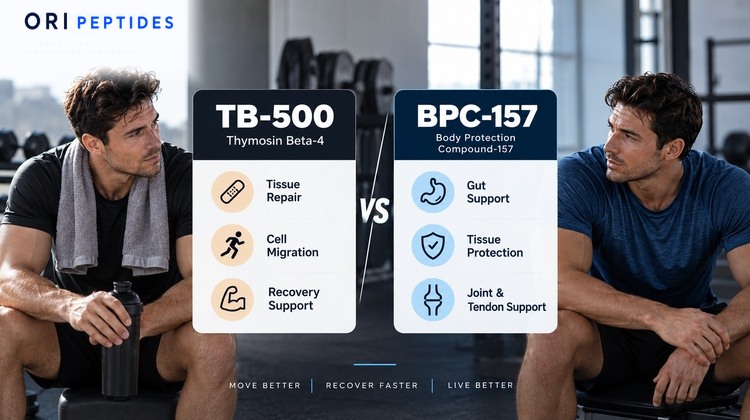
- TB-500’s proposed mechanism starts with thymosin beta-4’s natural role in actin regulation, the cell’s internal scaffolding, extending to cell migration, new blood vessel formation, stem cell maturation, and reduced inflammatory activity.
- BPC-157’s proposed mechanism runs through three connected pathways: promoting new blood vessel growth, protecting cells from damage, and interacting with growth factor signaling involved in tissue repair.
| Feature | TB-500 | BPC-157 |
|---|---|---|
| Origin | Synthetic peptide based on thymosin beta-4 | Fragment of a stomach-juice protein |
| Proposed mechanism | Cell migration, angiogenesis, stem cell maturation | Angiogenesis, cell protection, growth factor signaling |
| Regulatory status | Not approved; sold for research use only | Not approved; sold for research use only |
| Anti-doping status | Banned by the World Anti-Doping Agency | Banned by the World Anti-Doping Agency |
| Ever an approved drug? | No, research compound only | No, research compound only |
The overlap between them is part of why they’re studied together so often: both are proposed to support new blood vessel growth and cellular repair activity, just by different upstream routes.
See also: BPC-157 Dosage & Reconstitution Research Guide
What Recovery Research Examines, and How They Differ
Because the two compounds have different research histories, the evidence behind each looks different too.
BPC-157’s research record centers on tendon and ligament healing, gut protection, and wound closure, mostly in rodent studies, along with a small amount of human data from one retrospective study and one Phase I trial. TB-500’s preclinical research spans a wider range of tissue types. One detail worth knowing: some of the human wound-healing data associated with TB-500 actually comes from broader thymosin beta-4 research, a related molecule, rather than from trials of TB-500 itself.
| TB-500 | BPC-157 | |
|---|---|---|
| Main focus studied | Cell migration, blood vessel growth, and wound healing across several tissue types | Tendon and ligament repair, gut protection, general wound healing |
| Human research amount | Preclinical for TB-500 itself; related human data comes from broader thymosin beta-4 trials | One small retrospective study and one Phase I trial |
| Regulatory attention | Reviewed by an FDA pharmacy compounding advisory committee in July 2026 | Reviewed by the same committee in July 2026, with a non-binding 8 to 6 vote |
| Key difference | Wider research base across tissue types, with related human data drawn from a companion molecule | Focused research scope, with the human data that exists specific to BPC-157 itself |
The short version: TB-500’s preclinical research covers more ground, and some of the human evidence associated with it comes from a related molecule, broader thymosin beta-4, rather than TB-500 itself. BPC-157’s research is more concentrated, and what human data exists was collected on BPC-157 specifically. Neither compound has been tested directly against the other in a published trial, so this comparison draws on two separate research programs rather than one head-to-head study.
INJURY AND RECOVERY
TB-500
INJURY AND RECOVERY
BPC-157
Dosage
There’s no established, publicly validated research dose for either compound, and this guide won’t provide one. Any specific number circulating online for either peptide is extrapolated from preclinical research or repeated from other unverified sources.
- Mixing the powder is the same first step either way. Before any research quantity can be measured out, the freeze-dried peptide needs to be reconstituted with a sterile liquid. Researchers typically use bacteriostatic water as the diluent, and our Concentration Calculator does the concentration math automatically.
- Doses reported in the literature are scaled to specific preclinical models. They don’t convert cleanly to a human amount for either compound.
- This is research material, not a treatment plan. Both compounds, when sold for research, are meant for laboratory use by qualified professionals, not a personal dosing schedule.
See also: TB-500 Dosage & Reconstitution Research Guide
Handling and Storage
Both peptides are handled the same basic way as most other research peptides, with one caveat worth flagging.
- They ship as a freeze-dried powder. Each arrives in a sealed vial as a dry powder that needs to be mixed with a sterile liquid, usually bacteriostatic water, before it can be measured out.
- Cold and dark, before and after mixing. Unmixed powder should stay refrigerated or frozen and out of direct light. Once mixed, the solution should stay refrigerated and get used within the timeframe the supplier states.
- Avoid repeated freezing and thawing. Moving a vial in and out of the freezer repeatedly degrades the peptide faster than steady refrigeration does.
- Don’t assume they behave identically. They’re structurally different peptides, and stability data for one shouldn’t be assumed to apply to the other without checking the specific research or supplier documentation.
FAQ
Is TB-500 the same thing as BPC-157?
They’re related in how they’re studied, but structurally different peptides with different proposed mechanisms, TB-500 through thymosin beta-4’s role in cell migration and BPC-157 through angiogenesis and growth factor signaling. Researchers study both for similar recovery outcomes, which is why they’re often discussed together.
Which one has more research behind it?
It depends how the question is framed. TB-500’s preclinical research spans more tissue types, and some of its associated human data comes from a related molecule, broader thymosin beta-4. BPC-157’s research is more concentrated, and its human data is specific to BPC-157 itself.
Has anyone directly compared TB-500 and BPC-157 in a trial?
Not yet, in a published head-to-head study. Any comparison today draws on two separate research programs with different designs, rather than one controlled trial.
Are both banned in competitive sports?
Yes. The World Anti-Doping Agency has banned both TB-500 and BPC-157.
Research Use Disclaimer
This content is provided for Research Use Only (RUO). The compounds discussed are not drugs, dietary supplements, foods, or cosmetics, and are not intended for human or animal consumption, diagnostic use, or therapeutic use of any kind. They have not been evaluated by the FDA for safety or efficacy in humans. Any research use must be conducted by qualified professionals in a controlled laboratory environment, in accordance with all applicable institutional, local, and federal regulations.
Sources
- Goldstein AL, Hannappel E, Kleinman HK. Thymosin beta4: actin-sequestering protein moonlights to repair injured tissues. Trends in Molecular Medicine. 2005;11(9):421-429.
- Sikiric P, et al. Stable Gastric Pentadecapeptide BPC 157 and Wound Healing. Frontiers in Pharmacology.
- U.S. Food and Drug Administration. Pharmacy Compounding Advisory Committee meeting materials, July 2026, review of bulk drug substances including TB-500 and BPC-157.