BPC-157 is one of the most talked-about research peptides online, and most of that conversation is about dosing — how much, how often, and how to mix it. Here’s a plain explanation of where those numbers actually come from, how people typically prepare and measure it, and why none of it is backed by human clinical trials.
Key Takeaways
- No health authority — not the FDA, not any equivalent in Europe or elsewhere — has approved a dose for BPC-157 in people, because it has never gone through human clinical trials.
- The numbers you’ll see online (usually 200–500 micrograms per dose, once or twice a day) come from animal research and informal habits within the research community — not from studies in people.
- Most people who use it inject it just under the skin, though some discuss taking it by mouth or applying it near a specific area.
- Mixing (reconstituting) the powder correctly is where most mistakes happen — mixing up micrograms and milligrams can turn a normal dose into one that’s 1,000 times too strong.
- People typically describe using it for 4–8 weeks at a time, then taking a break. There’s no research on what happens with longer or repeated use.
- BPC-157 is sold as a research chemical, not a medicine or supplement. Talk to a doctor or other qualified healthcare provider before considering it.
What Is BPC-157?
BPC-157 (short for “Body Protection Compound-157”) is a lab-made peptide — a short chain of amino acids, the same building blocks that make up proteins. It’s modeled on a piece of a protein that’s naturally found in stomach juice. Scientists have studied it mainly in animals and in lab dishes, looking at how it might help the body repair tissue, grow new blood vessels, and protect the digestive system.
It’s also one of the most-searched peptides online, which is part of the problem: a lot of people are looking for dosing information, but no large human study has ever tested it for safety or effectiveness. So every number circulating online is really just a common habit or a rough guess, not an approved recommendation. One especially important thing to get right is the unit: mixing up micrograms (mcg) with milligrams (mg) is easy to do by accident, and it means the difference between a normal dose and one that’s 1,000 times too strong.
What Does the Research Actually Show?
Almost everything published on BPC-157 comes from animal studies, and there’s a fair amount of it — over 100 studies at this point, with the number growing each year. In rats and mice, researchers have reported things like faster tendon healing and smaller stomach ulcers compared to untreated animals. But those studies dose the animals based on their body weight, using amounts so small they’re measured in millionths or billionths of a gram per kilogram — and that doesn’t translate directly into a human dose.
The big gap is simple: nobody has published solid data on how BPC-157 behaves in the human body — how much gets absorbed, how the body breaks it down, or at what point it might become harmful. Scientists can try to estimate a “human equivalent” dose from animal data using body-weight math, but that’s an educated guess, not something tested in real people. So every human dosage figure you see online should be treated as a rough estimate or a community habit, not a proven or approved number.
Doses People Commonly Use
Within the online research community, doses are almost always measured in micrograms (mcg) — a very small unit; there are 1,000 micrograms in a single milligram. Most people describe using somewhere between 200 and 500 mcg per dose, once or twice a day. Some instead calculate a dose based on body weight (roughly 1–10 mcg per kilogram), which lands in a similar range for most adults.
Ranges commonly described in informal use — these are habits, not medical recommendations.
| Type | Typical Amount | How Often | Notes |
|---|---|---|---|
| Starting / cautious | 200–250 mcg | Once a day | Often used first, to see how the body responds |
| Standard | 250–500 mcg | Once or twice a day | The range mentioned most often |
| Applied near a specific area | 200–300 mcg | Near the area of interest | Discussed mainly for soft-tissue research |
Here’s why the units matter so much: a typical 5 mg vial actually holds 5,000 mcg of peptide. A 250 mcg dose is only about 1/20th of that vial — a very small amount once it’s mixed into liquid. Reading “250 mcg” as “250 mg” would mean a dose 1,000 times too high, so it’s always worth double-checking the units before measuring anything out.
Some people split their daily amount into a morning and evening dose, reasoning that it doesn’t stay active in the body very long. Others just take one dose a day for simplicity. There’s no human research showing either approach works better.
How Is It Usually Taken?
Injecting it just under the skin (subcutaneous injection) is by far the most common approach, usually with a small insulin syringe. It’s simple, and the amounts involved are small. Some people inject it close to a specific area they’re focused on — for example, near an injured tendon in animal studies — based on the idea that it works locally. Others believe it works throughout the whole body, in which case where you inject wouldn’t matter much. There’s no human research settling that question either way.
Taking it by mouth comes up a lot in discussions about gut health, since BPC-157 originally comes from a protein found in the stomach and seems to hold up well there in animal studies. But nobody has established how much of an oral dose actually gets absorbed in humans, so there’s no reliable oral dose to point to.
| Method | How Common | Good to Know |
|---|---|---|
| Under the skin (subcutaneous) | Most common | Small amount, fairly simple technique |
| By mouth | Common in gut-health discussions | Unclear how much the body actually absorbs |
| Into the muscle (intramuscular) | Less common | Deeper injection, bigger needle |
Whichever method is used, clean, sterile technique matters a lot — reusing needles or working in unclean conditions can cause infections, and any injection carries some risk. This shouldn’t be done without guidance from a healthcare professional.
How to Mix It Correctly
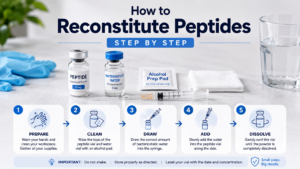
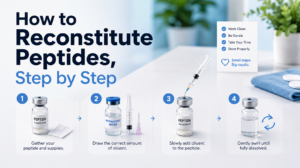
BPC-157 usually comes as a freeze-dried powder in a small vial. Before it can be measured or used, it has to be dissolved in a sterile liquid — this step is called reconstitution, and it’s where most measurement mistakes happen, so it’s worth understanding even if a professional is the one actually preparing it.
The liquid most commonly used is bacteriostatic water — sterile water with a tiny amount of alcohol added to stop bacteria from growing, which lets the mixed solution be kept refrigerated for a few weeks. Plain sterile water or saline is sometimes used instead, but it doesn’t have that protective ingredient, so the mixture doesn’t last as long.
The basic idea is simple: strength = amount of peptide ÷ amount of liquid added. Adding more or less water doesn’t change how much peptide is in the vial overall — it just changes how much liquid you need to draw up for a given dose.
Example, using a 5 mg (5,000 mcg) vial:
- Add 2 mL of bacteriostatic water. That makes the strength 2,500 mcg per mL.
- On a standard insulin syringe (marked 0–100), each small unit equals 25 mcg.
- So a 250 mcg dose is 10 units on that syringe, and a 500 mcg dose is 20 units.
In practice, people generally: wipe both the powder vial and the water vial with an alcohol swab; draw up the water and let it trickle slowly down the inside wall of the vial rather than squirting it straight onto the powder; gently swirl the vial (never shake it) until the powder fully dissolves; and store it in the fridge right away. Shaking can damage the peptide, so a slow swirl is enough. Because the strength changes every time you use a different amount of water, it’s smart to write the final concentration on the vial so it’s never guessed at later.
How Long Do People Typically Use It?
Just like dosing, the length of use is based on habit, not science. Most people describe using it for 4 to 8 weeks, then taking a break. The reasoning usually points to how long tissue repair seems to take in animal studies, but no human trial has actually tested what the ideal length should be.
Some people use the same dose every day for the whole stretch; others start a bit stronger and taper down. Neither approach is backed by human data.
Because there’s no research on long-term or repeated use, we genuinely don’t know what happens over time. One thing worth being aware of: BPC-157 is thought to help new blood vessels grow, which sounds good for healing, but in theory could be a concern in situations where extra blood vessel growth isn’t wanted. The safest general approach is to use it for the shortest amount of time that fits the goal, treat the lack of long-term data as a real limitation rather than something to brush past, and talk to a doctor about timing rather than just following whatever’s described online.
What Might Change the Right Dose
Body weight is the factor people mention most — the idea being that someone heavier would use a bit more, similar to how it’s dosed in animal studies. But again, this is borrowed from animal research, not a formula that’s been proven in people.
What it’s being used for also plays a role. People interested in gut-related questions tend to lean toward taking it by mouth, while those focused on tendons, muscles, or other soft tissue tend to inject it, sometimes near the specific area.
Quality and accurate labeling matter more than people often realize. Research peptides vary a lot in quality, and if a vial is mislabeled or impure, every dose calculated from it will be wrong too. Independent lab testing (a certificate of analysis) is really the only way to have any confidence in what’s actually in a vial.
Personal factors — age, overall health, other medications, and individual tolerance — all affect how a person’s body handles any active compound. None of this has actually been studied for BPC-157 in humans, though. In plain terms, nobody can currently say what the “right” dose is for a specific person, which is exactly why talking to a healthcare professional who knows your health history matters — it’s the closest thing to real personalization these generic numbers can get.
Is It Safe?
Animal studies have generally found BPC-157 to be well tolerated in the short term, and peptides as a group tend to cause fewer unrelated side effects than typical drugs because they act in a more targeted way. But here’s the key point: we simply don’t have human safety data, and that’s not the same as proof of safety. “No side effects seen in limited studies” is very different from “safe.”
People in online research communities sometimes mention mild, temporary effects like irritation where they injected, slight nausea, tiredness, or feeling lightheaded — but these reports aren’t from controlled studies, so they can’t be reliably pinned on BPC-157 itself. Without proper monitoring, we don’t really know how often side effects happen or how serious they can get.
The blood-vessel-growth effect mentioned earlier is worth extra caution for anyone with a relevant health condition — that’s a reason to talk to a doctor first, not to experiment on your own. And regardless of what BPC-157 itself does, everyday risks still apply: using clean equipment, measuring doses accurately, storing it properly in the fridge, and knowing the product is actually pure all matter for safety.
Before considering BPC-157: talk to a qualified healthcare provider first — especially if you take other medications, manage an ongoing health condition, or are pregnant or breastfeeding.
Is It Legal?
BPC-157 hasn’t been approved for human use by the FDA, its European counterpart, or other major health regulators, because it’s never completed the clinical trial process approval requires. That’s the reason there’s no official dose. In most places it’s sold labeled “for research use only,” and it isn’t a legal supplement or medicine.
In the United States, the FDA has sent warning letters to companies selling unapproved peptide products, and BPC-157 has come under scrutiny around pharmacy compounding. Rules differ quite a bit from country to country, and bringing research peptides across borders — or just having them — can carry legal risk depending on where you live.
For competitive athletes, there’s an added layer: peptides and growth factors fall under categories that anti-doping organizations monitor, so using an unapproved peptide could break the rules of a sport even if it isn’t named specifically.
In short, the legal picture is unsettled and varies by location. Anyone considering BPC-157 should check the current rules where they live, understand that “research use only” isn’t just a formality, and talk to a healthcare professional before making any decisions.
Frequently Asked Questions
What’s a typical BPC-157 dose?
Most commonly, people describe using 200–500 micrograms (mcg) per dose, once or twice a day, for 4–8 weeks at a time. These are habits based on animal research and community practice — not doses proven safe or effective in people. No health authority has approved a human dose, so it’s worth talking to a healthcare professional before considering it.
How do you mix BPC-157?
It comes as a freeze-dried powder that gets mixed with bacteriostatic water. For a 5 mg (5,000 mcg) vial, adding 2 mL of water gives a strength of 2,500 mcg per mL — meaning each small unit on a standard insulin syringe equals 25 mcg. Add the water slowly along the inside of the vial, swirl gently instead of shaking, and keep it refrigerated with the strength written on the label.
What’s the most common way to take it?
Injecting it just under the skin is the most common method, mainly because it’s simple and only requires a small amount. Taking it by mouth comes up often in gut-health discussions, though it isn’t clear how much of an oral dose the body actually absorbs.
How long do people typically use it for?
Commonly for 4–8 weeks, followed by a break. That’s a habit, not a proven timeframe — there’s no research on what longer or repeated use does.
Is BPC-157 safe and legal?
Nobody can say for certain either way, since there’s no published human safety research — animal studies look reassuring, but that doesn’t carry over automatically to people. Legally, it isn’t approved for human use anywhere major and is typically sold “for research use only,” with rules varying by country. Check local laws and talk to a healthcare professional before deciding anything.
Sources
- Sikiric P, et al. (2022). Stable Gastric Pentadecapeptide BPC 157 and Wound Healing. Frontiers in Pharmacology.
- Staresinic M, et al. (2003). Gastric pentadecapeptide BPC 157 accelerates healing of transected rat Achilles tendon. Journal of Orthopaedic Research.
- Chang CH, et al. (2011). The promoting effect of pentadecapeptide BPC 157 on tendon healing involves tendon outgrowth, cell survival, and cell migration. Journal of Applied Physiology.
- Gwyer D, et al. (2019). Gastric pentadecapeptide body protection compound BPC 157 and its role in accelerating musculoskeletal soft tissue healing. Cell and Tissue Research.
- Sikiric P, et al. (2016). Brain-gut Axis and Pentadecapeptide BPC 157: Theoretical and Practical Implications. Current Neuropharmacology.
- Seiwerth S, et al. (2018). BPC 157 and Standard Angiogenic Growth Factors. Current Pharmaceutical Design.
This article is for general information only and isn’t medical advice. BPC-157 hasn’t been approved for human use by the FDA, its European counterpart, or other major health regulators, and nothing here replaces guidance from a qualified healthcare professional. Anyone considering it should talk to a doctor first.
This overview is based on publicly available animal and lab research, along with habits commonly described in online research communities. It isn’t an endorsement of buying, using, or self-administering BPC-157.