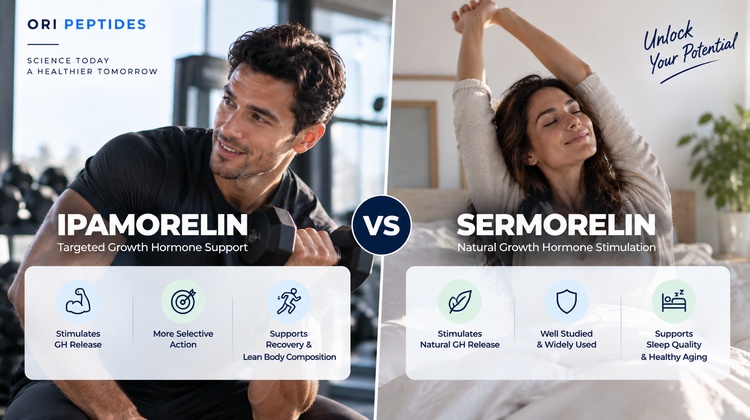
Ipamorelin and sermorelin both come up when people talk about growth hormone research. The names sound alike and the goal sounds alike, so it’s easy to assume they’re basically the same thing. They aren’t. Here is what each one is, how they work, and how researchers compare ipamorelin vs sermorelin, in plain terms.
What Is Ipamorelin?
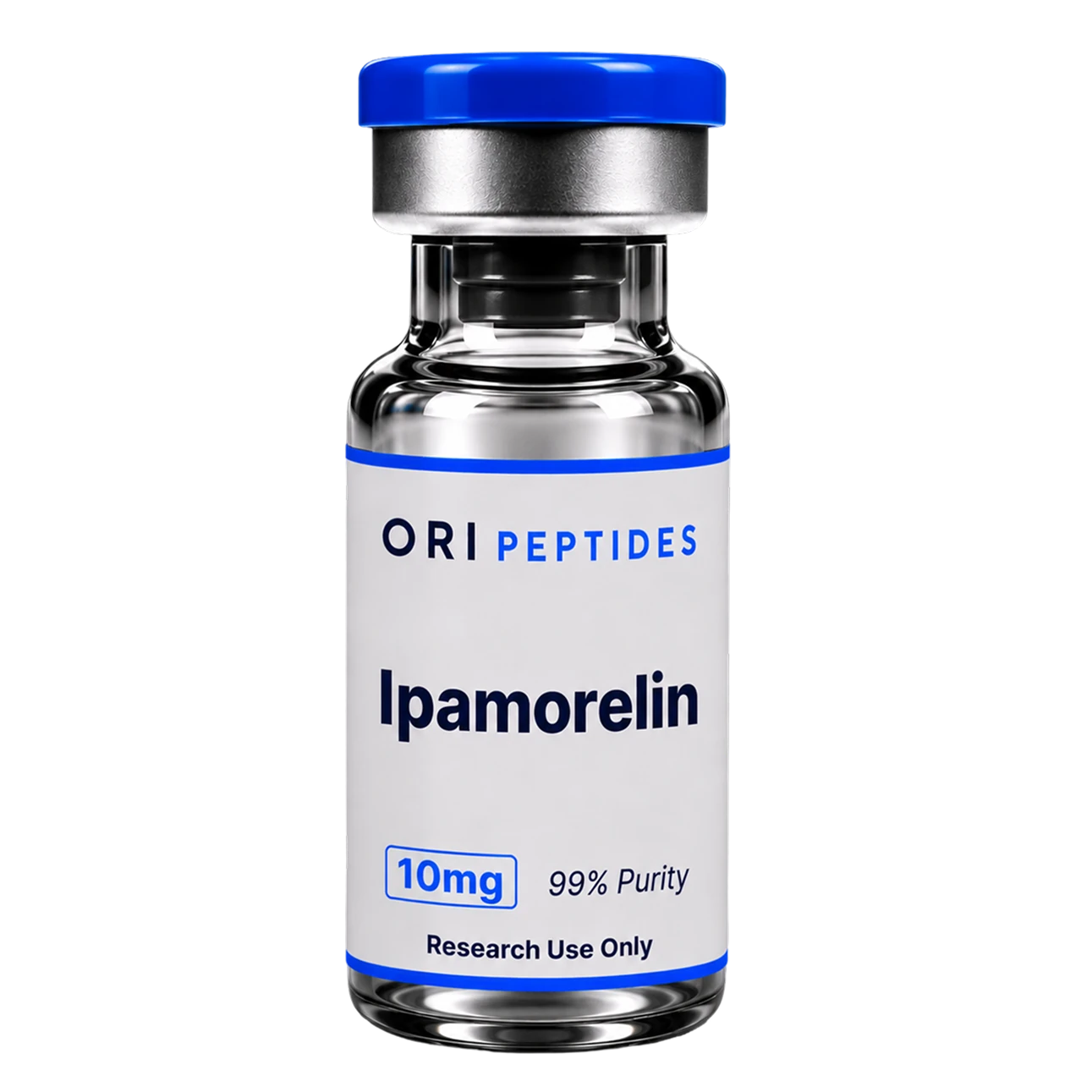
Ipamorelin is a small, lab-made peptide, meaning it’s a short chain of building blocks called amino acids. It’s built from just five of them, which makes it one of the shortest peptides used in growth hormone research. It was designed to copy ghrelin, the hormone your body releases when you’re hungry. Ghrelin does more than make you feel hungry, though. It also tells the pituitary gland (a small gland at the base of the brain) to release growth hormone, and that second job is the one ipamorelin was built to copy.
Ipamorelin has never been approved as a medicine. It is made and sold strictly as a research compound.
What Is Sermorelin?
Sermorelin is also a peptide, but a longer one, made of 29 amino acids instead of five. Instead of copying ghrelin, it copies a piece of a different hormone called growth hormone-releasing hormone, or GHRH for short. GHRH is the hormone your brain normally sends to the pituitary gland to tell it to release growth hormone, so sermorelin works by copying that natural signal.
Unlike ipamorelin, sermorelin does have a history as an approved drug. It was sold under the brand name Geref starting in 1997, used to help check for and treat growth hormone problems in children. The manufacturer stopped making it in 2008 for business reasons, not because of any safety problem, and it isn’t currently sold as an approved medicine.
How Does Each One Work?
Both peptides end with the same result, more growth hormone released from the pituitary gland, but they get there through two different doors.
- Ipamorelin knocks on the “hunger hormone” door. It locks onto the same landing spot on cells, called a receptor, that ghrelin normally uses.
- Sermorelin knocks on the “release hormone” door. It locks onto a different receptor, the one your body’s own GHRH normally uses.
Because these are two separate doors, researchers have looked at using both peptides together, on the idea that opening both at once produces a bigger effect than opening just one.
| Feature | Ipamorelin | Sermorelin |
|---|---|---|
| What it is | A short peptide, just 5 amino acids, built to copy ghrelin | A longer peptide, 29 amino acids, built to copy GHRH |
| How it works | Locks onto the ghrelin receptor to release growth hormone | Locks onto the GHRH receptor to release growth hormone |
| What it copies | Ghrelin (the “hunger hormone”) | Growth hormone-releasing hormone (GHRH) |
| Approximate weight | About 712 grams per mole | About 3,358 grams per mole |
| Ever an approved drug? | No, research compound only | Yes, sold as Geref from 1997 to 2008 |
Benefits of Ipamorelin and Sermorelin, and How They Differ
Because the two peptides come from different research backgrounds, the benefits studied for each one look a little different too.
Ipamorelin’s research has focused mainly on how targeted its effect is. Studies have found it raises growth hormone without moving other hormones much, such as cortisol (a stress hormone) or prolactin (a hormone tied to milk production), which older growth-hormone peptides tended to affect. That narrow, focused action is the main thing ipamorelin is known for. It has also been tested, separately, as a possible way to help the bowels recover faster after surgery, and animal studies have looked at its effect on body weight and bone growth.
Sermorelin’s research record is older and comes from real, approved medical use. Because it worked through the body’s own GHRH pathway, it was studied for releasing growth hormone in short bursts, the way the body naturally does, instead of one steady flow. Decades of use as an approved treatment for children with growth hormone problems also means there’s a large, well-documented body of human data behind it.
| Ipamorelin | Sermorelin | |
|---|---|---|
| Main benefit studied | Releases growth hormone with little effect on other hormones like cortisol or prolactin | Restores a natural, bursting pattern of growth hormone release |
| Other research areas | Bowel recovery after surgery; body weight and bone growth in animal studies | Once used as a test to check whether the pituitary gland was working properly |
| How much human research exists | Newer, more limited human research | Decades of use in an approved medical product |
| Key difference | Narrower, more targeted effect; shorter research history | Works through the body’s natural pathway; longer track record of human use |
The short version: ipamorelin is chosen for how narrowly it targets growth hormone alone, while sermorelin is chosen for working through the body’s own natural release pathway, backed by a longer track record of human use.
HORMONE THERAPY
Ipamorelin
Dosage
There is no single, official dose for either peptide in research use, and this guide will not suggest one. What gets used in a study depends on the specific research design, the equipment being used, and the exact question being asked.
A few general points are worth knowing instead:
- Sermorelin’s approved product was dosed by body weight. As a licensed drug, it was given as a shot just under the skin, with the amount worked out from the person’s weight, similar to how many hormone medicines are dosed.
- Ipamorelin’s human research is limited to a small number of published studies. Because there isn’t a long history of approved medical use behind it, there’s less standard dosing information available compared to sermorelin.
- Mixing the powder is the same first step either way. Before any research dose can be measured out, the freeze-dried peptide has to be mixed with a liquid first. Our peptide reconstitution calculator does that math automatically.
- This is research material, not a treatment plan. Both compounds discussed here are meant for laboratory research by qualified professionals, not for a personal dosing schedule.
Handling and Storage
Both peptides are handled the same way as most other research peptides.
- They ship as a freeze-dried powder. The peptide arrives in a sealed vial as a dry powder, which needs to be mixed with a liquid, usually a special sterile water with a preservative in it called bacteriostatic water, before it can be measured out.
- Cold and dark, before and after mixing. Unmixed powder should be kept refrigerated or frozen and out of direct light. Once mixed, the solution should stay refrigerated and get used within the timeframe the supplier states.
- Avoid repeated freezing and thawing. Going in and out of the freezer over and over can break the peptide down faster, so it’s best to keep the mixed solution in the refrigerator rather than the freezer for regular use.
This content is provided for Research Use Only (RUO). The compounds discussed are not drugs, dietary supplements, foods, or cosmetics, and are not intended for human or animal consumption, diagnostic use, or therapeutic use of any kind. They have not been evaluated by the FDA for safety or efficacy in humans. Any research use must be conducted by qualified professionals in a controlled laboratory environment, in accordance with all applicable institutional, local, and federal regulations.
FAQ
Is ipamorelin the same thing as sermorelin?
No. They lock onto different receptors in the body. Ipamorelin copies ghrelin and uses the ghrelin receptor, while sermorelin copies GHRH and uses the GHRH receptor. Both end up triggering growth hormone release, but through separate paths.
Which one has more research behind it?
Sermorelin has the longer track record, since it was an approved medical product for over a decade. Ipamorelin’s human research is newer and more limited, though it is well known for how selectively it targets growth hormone release.
Why would researchers use both together?
Since they work through two separate receptors, some research pairs a GHRH-type peptide with a ghrelin-type peptide like ipamorelin to see whether triggering both pathways at once produces a stronger effect than either one alone.
Is either peptide FDA-approved today?
No. Sermorelin was approved as Geref from 1997 until the manufacturer discontinued it commercially in 2008. Ipamorelin has never held that kind of approval. Both are currently sold and studied strictly as research compounds.
Sources
- Wikipedia. Ipamorelin, its structure, receptor selectivity, and clinical trial and research history.
- Wikipedia. Sermorelin, its structure, mechanism, and FDA approval and discontinuation history.
Comparing growth hormone peptides like ipamorelin and sermorelin fits into the broader hormone therapy research category, where a related growth hormone peptide, CJC-1295, is also covered in depth, along with an ipamorelin dosage guide for readers who want more detail on that compound specifically.