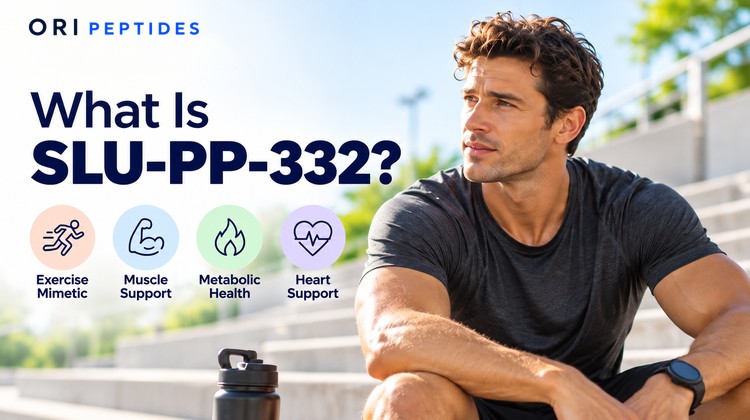
SLU-PP-332 is a lab-made compound that researchers call an “exercise mimetic.” That means it is studied for its ability to switch on some of the same body changes that exercise causes. It is not a weight-loss injection like the ones in the news, and it has not been tested in people. This guide explains what SLU-PP-332 is, how it works, what lab studies report, and why you will not find a proven dose here. It describes research only and is not advice for any person.
What Is SLU-PP-332?
SLU-PP-332 is a small man-made molecule. It is not a peptide (a short chain of amino acids), and it is not a hormone your body makes. A research group built it in the lab and described it in a 2023 paper in the journal ACS Chemical Biology. They wanted a research tool for studying a group of switches inside cells called estrogen-related receptors, or ERRs.
Almost everything known about SLU-PP-332 comes from lab work, meaning cells grown in dishes and lab models. A 2026 review in the journal Revista Medica de Chile looked at studies from 2020 to 2024 and said clinical trials are needed to confirm whether it works and whether it is safe in people. A 2024 commentary in the Journal of Renal Endocrinology also noted that the findings come from cell and lab studies, with no human trial data.
Many websites sell or discuss SLU-PP-332 as if it were a proven product. The research record does not support that. No source cited in this guide describes a trial in people.
How Does It Work?
Think of a cell as a small factory. Inside it are tiny power plants called mitochondria that turn food into energy. ERRs are master switches that tell the cell how many power plants to build and how much fuel to burn.
There are three ERRs, called alpha, beta, and gamma. SLU-PP-332 turns on all three, with the strongest effect on ERR alpha. The 2023 paper reported that in muscle cells it made the power plants work harder. It also set off a pattern of gene activity that looks like what happens after exercise. That is why it is called a “mimetic,” which means a copy. It copies some of exercise’s gene signals. It does not replace exercise.
This is different from the compounds in the retatrutide explained guide. Those work through gut hormone receptors on the cell surface and affect appetite and blood sugar. SLU-PP-332 works on switches inside the cell. For two other compounds that do act on gut hormone signals, see the cagrilintide and survodutide articles.
See also: Why Muscle-Building Peptides Are the Fitness Industry’s Next Frontier
SLU-PP-332 Benefits
No benefit has been shown in people. What follows are findings from lab studies, which may not carry over to humans.
- Muscle and endurance. The 2023 paper reported more of a muscle fiber type that burns fuel with oxygen, and better endurance in lab models.
- Fat and blood sugar. A 2024 study in the Journal of Pharmacology and Experimental Therapeutics tested it in lab models of obesity. It reported more energy use, more fat burning, less gain in fat mass, and better insulin sensitivity. Insulin is the hormone that helps cells take in sugar.
- The heart. A 2024 study in the journal Circulation used a lab model of heart failure. The treated hearts pumped better and had less scarring.
- The aging kidney. A 2023 study in the American Journal of Pathology gave it to aged lab models for 8 weeks. It reversed several age-related changes, including signs of damaged power plants and inflammation.
- Cell cleanup. A 2024 study found that ERRs help control autophagy, which is how cells clear out and recycle worn-out parts.
A 2026 review reported that in lab obesity models the compounds lowered body fat and improved blood sugar control, with no obvious toxicity. That is a lab finding. It says nothing yet about safety in people, and no long-term safety data exists.
See also: MK-677 Benefits, What Current Research Shows
SLU-PP-332 Dosage Information
There are no established dosage recommendations. No dose of SLU-PP-332 has been tested in people, so no one can say what amount is safe or useful. This guide does not suggest one.
You may see exact numbers online. These come from online user communities, shops, and clinic pages, not from clinical trials, and they differ enormously from site to site. Some of those sites admit this themselves. This guide does not repeat them, because there is no evidence behind them.
Here is what the research record says about study use and handling.
- Lab studies set their own amounts. The amounts in lab studies were chosen for those experiments and cannot be converted into an amount for a person.
- Oral use is unclear. A 2026 study reported that SLU-PP-332 lacks oral bioavailability, which means little of it gets into the body when swallowed. The same group described a related compound, SLU-PP-915, that works by mouth.
- Storage depends on the supplier. Because it is a small molecule and not a peptide, peptide storage and mixing rules may not apply. The supplier’s Certificate of Analysis and safety sheet are the right place to check.
ANTI-AGING
MOTS-C
Frequently Asked Questions
Is SLU-PP-332 a peptide?
No. It is a small man-made molecule. People often call it a peptide online, but it is not a chain of amino acids.
Has SLU-PP-332 been tested in people?
None of the sources cited here describes a trial in people. The 2026 review says clinical trials are needed.
Is SLU-PP-332 a GLP-1 drug?
No. GLP-1 compounds work through gut hormone receptors on the cell surface and are studied for appetite and blood sugar. SLU-PP-332 switches on ERRs inside the cell and is studied for energy use in muscle, fat, and other tissues.
Can SLU-PP-332 replace exercise?
There is no evidence that it can. Lab studies show it copies some of exercise’s gene signals, but exercise does much more than that for the body.
Why does it come up in sports testing?
Two 2026 studies mapped how human liver preparations break it down, to help anti-doping labs detect misuse. One of them notes that the World Anti-Doping Agency prohibits exercise mimetics and metabolic modulators.
What else is studied for energy and exercise signaling?
The MOTS-c guide explains another compound that researchers study in this area.
Key Takeaways
- SLU-PP-332 is a small man-made molecule, not a peptide, that switches on ERRs, the cell’s master switches for energy production.
- It is called an exercise mimetic because it copies some of exercise’s gene signals in lab studies. It does not replace exercise.
- Lab studies report effects on endurance, fat, blood sugar, the heart, and the aging kidney. None of these has been shown in people.
- No human trial is described in the sources cited here, and there is no established dose.
- It is different from GLP-1 compounds, which act on gut hormone receptors on the cell surface.
Research Use Disclaimer
This content is provided for Research Use Only (RUO). The compounds discussed are not drugs, dietary supplements, foods, or cosmetics, and are not intended for human or animal consumption, diagnostic use, or therapeutic use of any kind. They have not been evaluated by the FDA for safety or efficacy in humans. Any research use must be conducted by qualified professionals in a controlled laboratory environment, in accordance with all applicable institutional, local, and federal regulations.
Sources
- Billon C, et al. Synthetic ERRalpha/beta/gamma agonist induces an ERRalpha-dependent acute aerobic exercise response and enhances exercise capacity. ACS Chem Biol. 2023.
- Billon C, et al. A synthetic ERR agonist alleviates metabolic syndrome. J Pharmacol Exp Ther. 2024.
- Xu W, et al. Novel pan-ERR agonists ameliorate heart failure through enhancing cardiac fatty acid metabolism and mitochondrial function. Circulation. 2024.
- Wang XX, et al. Estrogen-related receptor agonism reverses mitochondrial dysfunction and inflammation in the aging kidney. Am J Pathol. 2023.
- Losby M, et al. The estrogen receptor-related orphan receptors regulate autophagy through TFEB. Mol Pharmacol. 2024.
- Billon C, et al. An orally active estrogen receptor-related receptor agonist, SLU-PP-915, enhances aerobic exercise capacity. J Pharmacol Exp Ther. 2026.
- de Souza-Lima J, et al. Pharmacological activation of ERRalpha/beta/gamma as an exercise mimetic, potential therapeutic applications. Rev Med Chil. 2026.
- Avliyakulov NK, et al. Analysis and identification of in vitro metabolites of exercise mimetic SLU-PP-332 ERRalpha/beta/gamma agonist for doping-control purposes. Drug Test Anal. 2026.
- Moller T, et al. In vitro metabolism and analytical characterization of SLU-PP-332 and SLU-PP-915, novel pan-ERR agonists with doping potential. Rapid Commun Mass Spectrom. 2026.
- Nasri H. New hopes on SLU-PP-332 as an effective agent for weight loss with indirect kidney protection efficacy, a nephrology point of view. J Ren Endocrinol. 2024.
Explore the anti-aging research category or the weight loss research category for related compounds, or view the MOTS-C research material and the full shop.