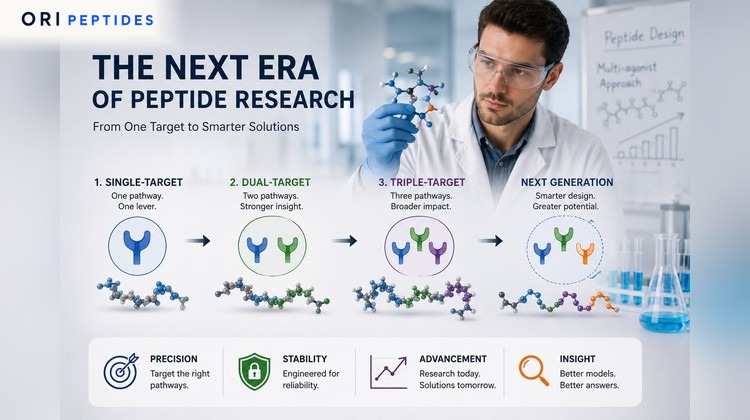
Metabolic peptide research has moved quickly from single-target GLP-1 compounds to molecules that act on two and even three hormone receptors at once. This article looks at how that design progression happened and where researchers are taking it next. This content is provided for Research Use Only (RUO).
The Story Everyone Already Knows
For the past few years, the headline has been simple: GLP-1 drugs changed the conversation around metabolic health, and single-target peptides became a cultural phenomenon almost overnight. That story has been told a hundred times. It’s also, from a research standpoint, already outdated.
While the public conversation is still catching up to single-target GLP-1 compounds, the research pipeline has moved two generations past them. The real story isn’t the drug everyone’s heard of. It’s what came after it, and how fast the field is moving.
Why Single-Target Was Always Going to Be a Phase
Single-receptor peptides proved a concept: that a synthetic molecule could reliably engage one metabolic pathway with precision. That was a genuine breakthrough, but it was also, by design, a limited one. One receptor means one lever. Researchers studying complex metabolic systems quickly ran into the same wall: real physiology doesn’t operate on a single pathway, so a single-target molecule can only ever tell part of the story.
That limitation is exactly what pushed the field toward multi-agonist design. It wasn’t a marketing pivot. It was a research necessity.
See also: Why Appetite Is a Bigger Research Puzzle Than Anyone Expected
The Pipeline Has Already Moved Twice
Here’s what’s easy to miss if you’re only following headlines: the field didn’t jump straight from “one target” to “the future.” It moved in deliberate steps.
- Single-target compounds, such as semaglutide, proved the core chemistry worked.
- Dual-target compounds, such as the GLP-1/GIP agonist tirzepatide, proved multiple pathways could be combined in one stable molecule.
- Triple-target compounds, with retatrutide as the clearest example, showed that a third pathway, the glucagon receptor, could be built into the same molecule. Retatrutide is still investigational and in Phase 3 clinical trials.
Each step wasn’t hype-driven. It was solving the specific limitation of the generation before it. That pattern is the actual signal worth paying attention to, not any single drug’s name recognition.
See also: What Is Retatrutide? Mechanism, Research & Uses
What “Next” Actually Looks Like
If the trajectory holds, the next phase of research isn’t necessarily “more receptors for the sake of more receptors.” It’s more targeted engineering:
- Pathway-specific precision. Designing molecules that hit exactly the combination of receptors relevant to a specific research question, rather than defaulting to maximum receptor count.
- Tissue-selective mechanisms. Next-generation research is increasingly focused on where a pathway is engaged, not just how many pathways are engaged.
- Longer-acting formulations. Extending the interval between required administrations in research models, reducing variability introduced by frequent dosing schedules.
- Combination-molecule modeling. Using single multi-agonist compounds to replace what used to require multi-compound research protocols, reducing confounding variables in comparative studies.
These directions follow the same design logic that produced dual- and triple-agonist peptides in the first place, though how far each one goes will depend on what the research actually shows.
Why This Matters for the Field, Not Just the Molecule
The reason multi-agonist peptides matter isn’t that any single compound is “the answer.” It’s that they represent a proof of concept the entire research field can build on. Once a triple-target molecule is shown to be synthesizable and stable, it resets the ceiling for what the next compound class can attempt. That’s the actual “era change”: not that one drug replaced another, but that the design constraints researchers assumed were fixed have moved.
The compounds getting attention right now aren’t the end state. They’re the current proof that the next generation is possible, and the pipeline behind them is already testing what comes after.
See also: What Is Tirzepatide? Mechanism & Research Explained
FAQ
What is a multi-agonist peptide?
A single molecule designed to activate more than one hormone receptor. Tirzepatide acts on two (GLP-1 and GIP), while retatrutide acts on three (GLP-1, GIP, and glucagon).
Is retatrutide approved?
No. Retatrutide is an investigational compound in Phase 3 clinical trials and has not been approved by the FDA or any other health authority.
Does adding more receptors always mean a better compound?
Not necessarily. The direction of current research is toward choosing the right combination of receptors for a specific question, and controlling where they act, rather than simply adding more targets.
Research Use Disclaimer
This content is provided for Research Use Only (RUO). The compounds discussed are not drugs, dietary supplements, foods, or cosmetics, and are not intended for human or animal consumption, diagnostic use, or therapeutic use of any kind. They have not been evaluated by the FDA for safety or efficacy in humans. Any research use must be conducted by qualified professionals in a controlled laboratory environment, in accordance with all applicable institutional, local, and federal regulations.
Sources
- Wilding JPH, et al. Once-Weekly Semaglutide in Adults with Overweight or Obesity (STEP 1). New England Journal of Medicine. 2021;384(11):989-1002.
- Jastreboff AM, et al. Tirzepatide Once Weekly for the Treatment of Obesity (SURMOUNT-1). New England Journal of Medicine. 2022;387(3):205-216.
- Jastreboff AM, et al. Triple-Hormone-Receptor Agonist Retatrutide for Obesity: A Phase 2 Trial. New England Journal of Medicine. 2023;389(6):514-526.